Licence: Public Domain Mark
Credit: The nervous system and its conservation. Source: Wellcome Collection.
Provider: This material has been provided by the Augustus C. Long Health Sciences Library at Columbia University and Columbia University Libraries/Information Services, through the Medical Heritage Library. The original may be consulted at the the Augustus C. Long Health Sciences Library at Columbia University and Columbia University.
100/248 (page 96)
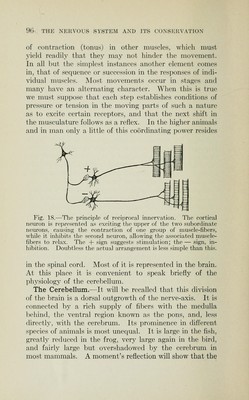
![of contraction (tonus) in other muscles, which must .vield readily that they may not hinder the movement. In all ])ut the simplest instances another element comes in, that of sequence or succession in the responses of indi- \ddual nmscles. Most movements occur in stages and many have an alternating character. When this is true we must suppose that each step establishes conditions of pressure or tension in the moving parts of such a nature as to excite certain receptors, and that the next shift in the musculature follows as a reflex. In the higher animals and in man only a little of this coordinating power resides Fig. IS.—The principle of reciprocal innervation. The cortical neuron is represented as exciting the upper of the two subordinate neurons, causing the contraction of one group of muscle-fibers, while it inhibits the second neuron, allowing the associated muscle- fibers to relax. The + sign suggests stimulation; the— sign, in- hibition. Doubtless the actual arrangement is less simple than this. in the spinal cord. Most of it is represented in the brain. At this place it is convenient to speak briefly of the physiology of the cerebellum. The Cerebellum.—It will be recalled that this division of the brain is a dorsal outgrowth of the nerve-axis. It is connected by a rich supply of fibers with the medulla behind, the ventral region known as the pons, and, less directly, with the cerebrum. Its prominence in different species of animals is most unequal. It is large in the fish, greatly reduced in the frog, very large again in the bird, and fairly large but overshadowed by the cerebrum in most mammals. A moment's reflection will show that the](https://iiif.wellcomecollection.org/image/b21206545_0100.jp2/full/800%2C/0/default.jpg)