Licence: Public Domain Mark
Credit: The nervous system and its conservation. Source: Wellcome Collection.
Provider: This material has been provided by the Augustus C. Long Health Sciences Library at Columbia University and Columbia University Libraries/Information Services, through the Medical Heritage Library. The original may be consulted at the the Augustus C. Long Health Sciences Library at Columbia University and Columbia University.
34/248 (page 30)
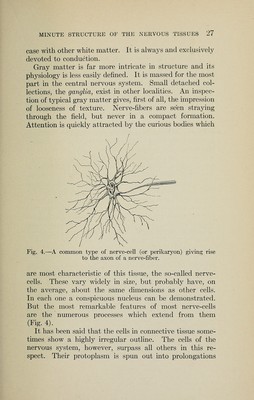
![has it;? nucleus in the gray matter, do we do well to call the portion about the nucleus the cell and to imply that the core of the fiber is not to be reckoned as belonging to it? It is reasona])lc to claim that the cell should he held to include all its extensions, no matter how prolonoed. Histologists have appreciated the force of this argument and have proposed words to denote more precisely the features under discussion. What we have generally called the nerve-cell may better be called the perikaryon, which means specifically around the nucleus. When we adopt this we find ourselves in need of a word for the combination of perikaryon, dendrites, and axon (or axons)—in short, for the nerve-cell in the best sense. The word supplied is neuron. The Neuron Theory.—It is now time to outline the conception of tlie anatomy and physiology of the nervous system which for twenty-five years has been the founda- tion of most presentations of these subjects. To do this will be, in part, to restate what has gone before, but we shall be led also to fresh considerations. The ideas to be explained are not to be received as surely demonstrated, but they have probably not seriously misled students in the past, however they may have to be modified in the future. New views are now urged by many skilled in- vestigators and we must not ignore them. Nevertheless, the traditional picture of the nervous elements and their relationships remains convenient for teaching and diagram- matic purposes. The neuron theory assumes that the whole system is capable of resolution into highly specialized cells of the nature already indicated. These neurons are said to be concatenated, which means enchained. The indi- vidual neuron is commonly supposed not to be continuous with any of its fellows, but it is supposed to affect and to be affected by them through synapses. The valve action emphasized above gives each neuron a certain regularity of performance; it can receive stimuli at certain points, but it cannot communicate them at the same places. So also](https://iiif.wellcomecollection.org/image/b21206545_0034.jp2/full/800%2C/0/default.jpg)