Licence: In copyright
Credit: The constitution of umbellulone. Pt. II / by Frank Tutin. Source: Wellcome Collection.
Provider: This material has been provided by The Royal College of Surgeons of England. The original may be consulted at The Royal College of Surgeons of England.
4/6 page 272
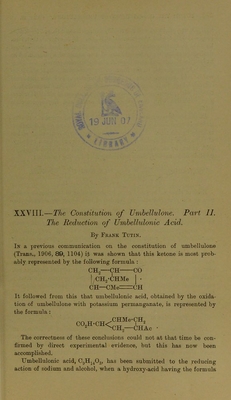
![CgHjgOg was produced, and this readily gives a lactone (b. p. 246—248° ; [a]o- 13-54°) having the formula, CgH^gOg. It is evident, therefore, that the closed ring contained in umbellulonic acid had been opened during the reduction by the addition of two atoms of hydrogen. The hydroxy-acid obtained must therefore be a chain compound. This hydroxy-acid, in the form of its potassium salt, is stable to- wards cold permanganate in neutral solution, and the keto-acid corresponding to it could not be obtained. When, however, it is treated with permanganate in presence of an excess of alkali, it under- goes oxidation with the formation of acetic and iaopropylsuccinic acids. In the previous communication {loc. cit.) it was shown that umbellu- lonic acid must contain either a methylpentamethylene or a dimethyl- tetramethylene ring. There are only two keto-acids containing either of these rings that are also capable of giving on reduction a hydroxy- acid, which, by subsequent oxidation, would yield acetic and isopropyl- succinic acids, namely, those possessing the following formulae : C02H-CH< CHMe-CHg CHg—CHAc I. PMp COgH-CH<^„ ^CHAc. II. Each of these acids would give, by the opening of the ring on reduc- tion at the place indicated by the dotted line, S-hydroxy-a-isopropyl-w- hexoic acid, CH3-CH(0H);CH2-CH2-CH(C02H)-CHMe2, and this acid by undergoing oxidation at the position indicated, would yield acetic and isopropylsuccinic acids. The product of the reduction of umbellulonic acid must therefore be \-^-hydroxy-a-isopropyl-n-hexoic acid. Formula II represents the pinononic acid obtained by Wagner by the oxidation of pinene {Ber., 1896, 29, 881) and it was shown in the previous communication that umbellulonic acid is neither identical nor stereoisomeric with it. Umbellulonic acid must, therefore, be correctly represented by formula I, that is, by the formula previously assigned to it. Experimental. Formation of \-h-Hydroxy-a-isopropyl-n-hexoix Acid. Fifteen grams of umbellulonic acid were dissolved in 100 c.c. of o absolute alcohol and the solution rendered alkaline by the addition of sodium ethoxide. Ten grams of sodium were then introduced in small pieces, and, when this had dissolved, a further 100 c.c. of alcohol, followed by 10 gram.s of sodium, were added. After the addition of water, the greater part of the alcohol was removed, and, on](https://iiif.wellcomecollection.org/image/b22425354_0006.jp2/full/800%2C/0/default.jpg)