Morris' human anatomy : a complete systematic treatise / edited by C.M. Jackson.
- Sir Henry Morris, 1st Baronet
- Date:
- [1933]
Licence: Public Domain Mark
Credit: Morris' human anatomy : a complete systematic treatise / edited by C.M. Jackson. Source: Wellcome Collection.
109/1506 page 91
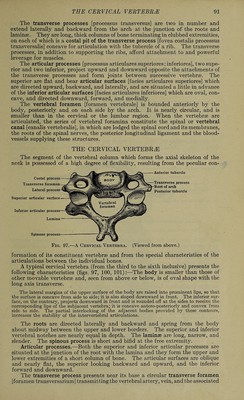
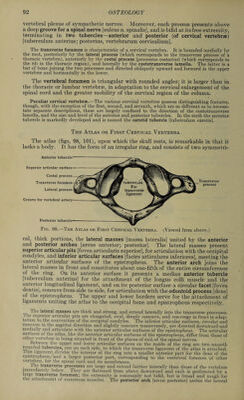
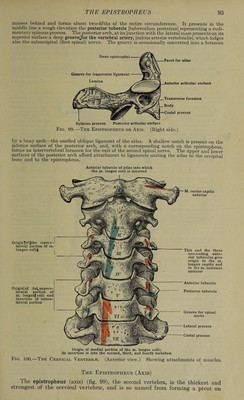
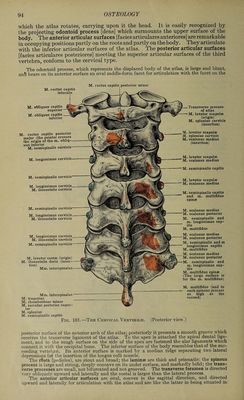
![The transverse processes [processus transversus] are two in number and extend laterally and backward from the arch at the junction of the roots and laminae. They are long, thick columns of bone terminating in clubbed extremities, on each of which is a costal pit of the transverse process [fovea costalis processus transversalis] concave for articulation with the tubercle of a rib. The transverse processes, in addition to supporting the ribs, afford attachment to and powerful leverage for muscles. The articular processes [processus articulares superiores; inferiores], two supe¬ rior and two inferior, project upward and downward opposite the attachments of the transverse processes and form joints between successive vertebrae. The superior are flat and bear articular surfaces [facies articulares superiores] which are directed upward, backward, and laterally, and are situated a little in advance of the inferior articular surfaces [facies articulares inferiores] which are oval, con¬ cave, and directed downward, forward, and medially. The vertebral foramen [foramen vertebrale] is bounded anteriorly by the body, posteriorly and on each side by the arch. It is nearly circular, and is smaller than in the cervical or the lumbar region. When the vertebrae are articulated, the series of vertebral foramina constitute the spinal or vertebral canal [canalis vertebralis], in which are lodged the spinal cord and its membranes, the roots of the spinal nerves, the posterior longitudinal ligament and the blood¬ vessels supplying these structures. THE CERVICAL VERTEBRAE The segment of the vertebral column which forms the axial skeleton of the neck is possessed of a high degree of flexibility, resulting from the peculiar con- Anterior tubercle Transverse process Root of arch Posterior tubercle Fig. 97.—A Cervical Vertebra. (Viewed from above.) formation of its constituent vertebrae and from the special characteristics of the articulations between the individual bones. A typical cervical vertebra (from the third to the sixth inclusive) presents the following characteristics (figs. 97, 100, 101):—-The body is smaller than those of other movable vertebrae and, seen from above or below, is of oval shape with the long axis transverse. The lateral margins of the upper surface of the body are raised into prominent lips, so that the surface is concave from side to side; it is also sloped downward in front. The inferior sur¬ face, on the contrary, projects downward in front and is rounded off at the sides to receive the corresponding lips of the subjacent vertebra; it is concave antero-posteriorly and convex from side to side. The partial interlocking of the adjacent bodies provided by these contours, increases the stability of the intervertebral articulations. The roots are directed laterally and backward and spring from the body about midway between the upper and lower borders. The superior and inferior vertebral notches are nearly equal in depth. The laminae are long, narrow, and slender. The spinous process is short and bifid at the free extremity. Articular processes.—Both the superior and inferior articular processes are situated at the junction of the root with the lamina and they form the upper and lower extremities of a short column of bone. The articular surfaces are oblique and nearly flat, the superior looking backward and upward, and the inferior forward and downward. The transverse process presents near its base a circular transverse foramen [foramen transversarium] transmitting the vertebral artery, vein, and the associated](https://iiif.wellcomecollection.org/image/b31356011_0109.jp2/full/800%2C/0/default.jpg)
 No text description is available for this image
 No text description is available for this image
 No text description is available for this image