Nervous and mental diseases / by Archibald Church and Frederick Peterson. With 338 illustrations.
- Church, Archibald, 1861-1952
- Date:
- 1903
Licence: Public Domain Mark
Credit: Nervous and mental diseases / by Archibald Church and Frederick Peterson. With 338 illustrations. Source: Wellcome Collection.
Provider: This material has been provided by the Augustus C. Long Health Sciences Library at Columbia University and Columbia University Libraries/Information Services, through the Medical Heritage Library. The original may be consulted at the the Augustus C. Long Health Sciences Library at Columbia University and Columbia University.
37/956 page 35
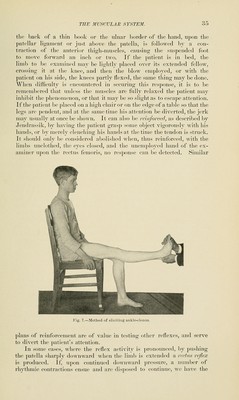
![the back of a thin book or the ulnar border of the hand, upon the patellar ligament or just above the patella, is followed by a con- traction of the anterior thigh-muscles, causing the suspended foot to move forward an inch or two. If the ])atient is in bed, the limb to be examined may be lightly placed over its extended fellow, crossing it at the knee, and then the blow employed, or with the patient on his side, the knees partly flexed, the same thing may be done. When difficulty is encountered in securing this response, it is to be remembered that unless the muscles are fully relaxed the patient may inhibit the phenomenon, or that it may be so slight as to escape attention. If the patient be placed on a high chair or on the edge of a table so that the legs are pendent, and at the same time his attention be diverted, the jerk may usually at once be shown. It can also be reinforced, as described hj Jendrassik, by having the patient grasp some object vigorously with his hands, or by merely clenching his hands at the time the tendon is struck. It should only be considered abolished when, thus reinforced, with the limbs unclothed, the eyes closed, and the unemployed hand of the ex- aminer upon the rectus femoris, no response can be detected. Similar f» Fig. 7.—Method of eliciting ankle-clonus. plans of reinforcement are of value in testing other reflexes, and serve to divert the patient's attention. In some cases, where the reflex activity is pronounced, by pushing the patella sharply downward when the limb is extended a rectus reflex is produced. If, upon continued downward pressure, a number of rhythmic contractions ensue and are disposed to continue, we have the](https://iiif.wellcomecollection.org/image/b21225953_0037.jp2/full/800%2C/0/default.jpg)