Nervous and mental diseases / by Archibald Church and Frederick Peterson. With 338 illustrations.
- Church, Archibald, 1861-1952
- Date:
- 1903
Licence: Public Domain Mark
Credit: Nervous and mental diseases / by Archibald Church and Frederick Peterson. With 338 illustrations. Source: Wellcome Collection.
Provider: This material has been provided by the Augustus C. Long Health Sciences Library at Columbia University and Columbia University Libraries/Information Services, through the Medical Heritage Library. The original may be consulted at the the Augustus C. Long Health Sciences Library at Columbia University and Columbia University.
85/956 page 83
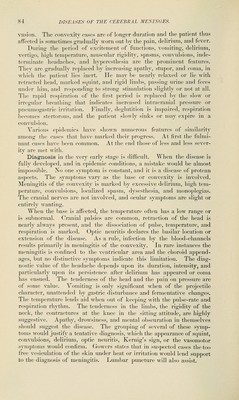
![Early in the attack the respiration may be quickened. Later, in the stupor and coma, it is often slow and irregular. The Cheyne-Stokes variety is often observed, and is of very serious though not absolutely of fatal import. The ordinary relations of respiration to the tempera- ture and pulse may be, and often are, disturbed. The urine shows the general febrile disturbance, and is scanty, high- colored, and heavy. Sometimes albumin and sugar are found in quan- tities varying from a trace to large amounts. They are significant of irritation of the medullary centers in the floor of the fourth ventricle. The tendon-reflexes may or may not be much modified. Sometimes they are exaggerated, more often decreased. It is not uncommon to find them diminishing as the depressed stage comes on. Their obliteration after the disease has lasted a week or ten days in protracted cases is often noticed. They may be more disturbed on one side than on the other. ■ 125 120 115 UJ 110 15 3 105 100 95 A A /> ^ ^\ -J u* \ \ 1 \ / \^ \ ^ V \ \ / n / \ / \ yy L / 1 f\ J I - / s. / \ 0- i ~/ \ 1 1 ' / V L/ 1 i / \ /Sj : . L L . \ h^ T r _i \ U i \ / Pv^ - t \ cc / \ J 1 \ V i / 44] / \ / \ : 1 / \X r: Jti- \_ i 4 1 1 4 LU 0- S / \ > / \ / 1 \l \ \ ' 1 / r 5 \ ^^ 1 / 1 H i 3 1 / 1 , 101° - 100° - J 1 \ \ A \ 1 / \V L 1 / \j V ~^ ^^ -,— - 1' \ K* 'V ^.m—J- cr^ ^■_- 1 i JE r \U V ^. / W 99°- 1 Fig. 28.—Partial temperature- and piilse-ciirves in a case of meningitis of the convexity, showing dissociation. Temperature, upper line; pulse, lower line. Eecord taken every four hours, commencing at midnight. Course.—No two cases present parallel conditions as to course, symptoms, or intensity. A fulminant case may end fatally in a day. Protracted cases extend over several weeks and some are clearly sub- acute. An ordinary non-epidemic case presents perhaps a week of malaise, a week of excitement, and a week of depression, which usually terminates in deepening coma and death by cardiac failure. At any time, even when the patient seems to be in extremis, the symptoms may clear away and convalescence follow. A remission of symptoms may give false hope, to be destroyed by the return of the serious features of the disease in all their intensity. When the basilar region is principally aifected, the course of the disease is likely to be cut short by bulbar in-](https://iiif.wellcomecollection.org/image/b21225953_0085.jp2/full/800%2C/0/default.jpg)