Chemical pathology : being a discussion of general pathology from the standpoint of the chemical processes involved / by H. Gideon Wells.
- Harry Gideon Wells
- Date:
- [1925]
Licence: Public Domain Mark
Credit: Chemical pathology : being a discussion of general pathology from the standpoint of the chemical processes involved / by H. Gideon Wells. Source: Wellcome Collection.
79/804 page 71
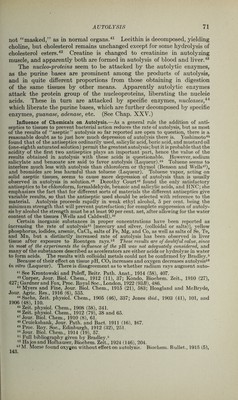
![not “masked,” as in normal organs.41 Lecithin is decomposed, yielding choline, but cholesterol remains unchanged except for some hydrolysis of cholesterol esters.42 Creatine is changed to creatinine in autolyzing muscle, and apparently both are formed in autolysis of blood and liver.43 The nucleo-proteins seem to be attacked by the autolytic enzymes, as the purine bases are prominent among the products of autolysis, and in quite different proportions from those obtaining in digestion of the same tissues by other means. Apparently autolytic enzymes attack the protein group of the nucleoproteins, liberating the nucleic acids. These in turn are attacked by specific enzymes, nucleases,44 which liberate the purine bases, which are further decomposed by specific enzymes, guanase, adenase, etc. (See Chap. XXV.) Influence of Chemicals on Autolysis.—As a general rule the addition of anti- septics to tissues to prevent bacterial action reduces the rate of autolysis, but as most of the results of “aseptic” autolysis so far reported are open to question, there is a reasonable doubt as to just how much depression of autolysis there is. Yoshimoto45 found that of the antiseptics ordinarily used, salicylic acid, boric acid, and mustard oil (one-eighth saturated solution) permit the greatest autolysis; but it is probable that the acidity of the first two antiseptics plays an important part, hence the value of the results obtained in autolysis with these acids is questionable. However, sodium salicylate and benzoate are said to favor autolysis (Laqueur).46 Toluene seems to interfere much less with autolysis than chloroform or thymol (Benson and Wells47), and bromides are less harmful than toluene (Laqueur). Toluene vapor, acting on solid aseptic tissues, seems to cause more depression of autolysis than is usually observed in autolysis in solution.48 Dorothy Court49 found the only satisfactory antiseptics to be chloroform, formaldehyde, benzoic and salicylic acids, and HNC; she emphasizes the fact that for different sorts of materials the different antiseptics give variable results, so that the antiseptic used should be selected with reference to the material. Autolysis proceeds rapidly in weak ethyl alcohol, 5 per cent, being the minimum strength that will prevent putrefaction; for complete suppression of autoly- sis by alcohol the strength must be at least 90 per cent, net, after allowing for the water content of the tissues (Wells and Caldwell).50 Certain inorganic substances in proper concentrations have been reported as increasing the rate of autolysis51 [mercury and silver, (colloidal or salts)], yellow phosphorus, iodides, arsenic, CaCl2, salts of Fe, Mg, and Co, as well as salts of Se, Te, and Mn, but a distinctly increased rate of autolysis has been observed in liver tissue after exposure to Roentgen rays.52 These results are of doubtful value, since in most of the experiments the influence of the pH was not adequately considered, and many of the substances described as accelerators are either acids or hydrolyze in water to form acids. The results with colloidal metals could not be confirmed by Bradley.5 Because of their effect on tissue pH, C02 increases and oxygen decreases autolysis53 in vitro (Laqueur). There is disagreement as to whether radium rays augment auto- 41 See Krontowski and Poleff, Beitr. Path. Anat., 1914 (58), 407. 42Corper, Jour. Biol. Chem., 1912 (11), 37; Kondo, Biochem. Zeit., 1910 (27), 427; Gardner and Fox, Proc. Royal Soc., London, 1922 (935), 486. 43 Myers and Fine, Jour. Biol. Chem., 1915 (21), 583; Hoagland and McBryde, Jour. Agric. Res., 1916 (6), 535. 44 Sachs, Zeit. physiol. Chem., 1905 (46), 337; Jones ibid., 1903 (41), 101, and 1906 (48), 110. 45 Zeit. physiol. Chem., 1908 (58), 341. 46 Zeit. physiol. Chem., 1912 (79), 38 and 65. 47 Jour. Biol. Chem., 1910 (8), 61. 48 Cruickshank, Jour. Path, and Bact. 1911 (16), 167. 49 Proc. Roy. Soc., Edinburgh, 1912 (32), 251. 60 Jour. Biol. Chem., 1914 (19), 57. 51 Full bibliography given by Bradley.5 52 Ha jos and Hofhauser, Biochem. Zeit., 1924 (146), 204. 63 M. Morse found oxygen without effect on autolysis. Biochem. Bullet., 1915 (5),](https://iiif.wellcomecollection.org/image/b29809344_0079.jp2/full/800%2C/0/default.jpg)


 No text description is available for this image
 No text description is available for this image
 No text description is available for this image