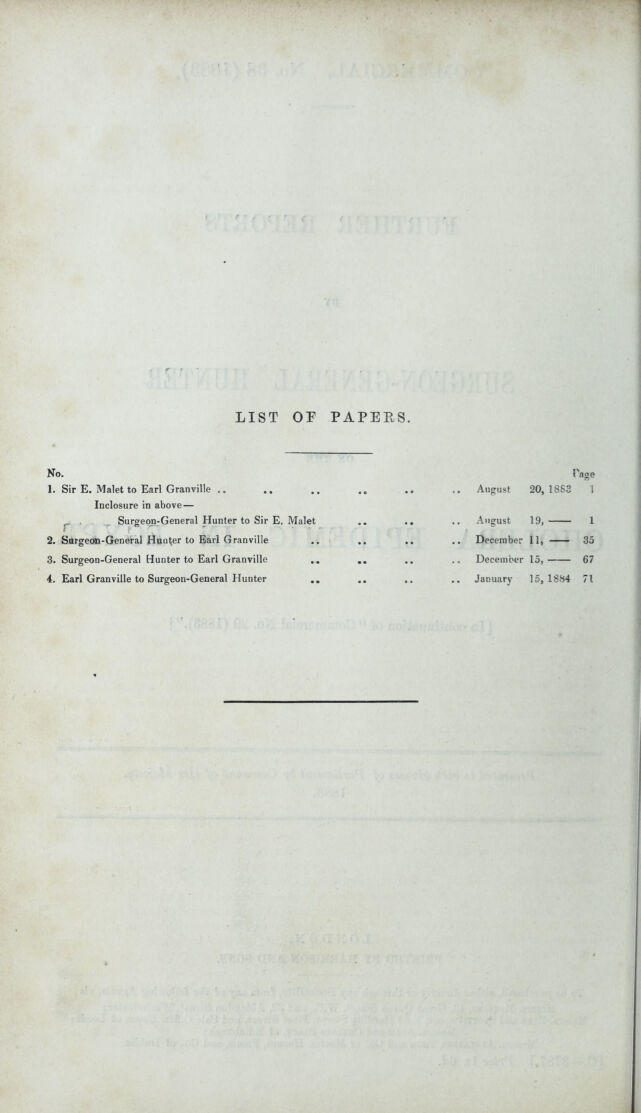
Commercial. No. 38 (1883). Further reports by Surgeon-General Hunter on the cholera epidemic in Egypt. [In continuation of "Commercial no. 29 (1883)."].
- Hunter, W. G.
- Date:
- 1883
Licence: Public Domain Mark
Credit: Commercial. No. 38 (1883). Further reports by Surgeon-General Hunter on the cholera epidemic in Egypt. [In continuation of "Commercial no. 29 (1883)."]. Source: Wellcome Collection.
Provider: This material has been provided by London School of Hygiene & Tropical Medicine Library & Archives Service. The original may be consulted at London School of Hygiene & Tropical Medicine Library & Archives Service.
53/80 page 51
![have at stake, often comes to be dependent on chance, and, as a rule, we are out- voted on questions of vital importance to the country. The opinions of the Board, 1 regret to say, are warped by considerations other than those which should govern their deliberations. As the reasons which brought the Board into existence have ceased, there does not seem to me to be any longer grounds for its retention. Although called the International Quarantine Board, it is in no sense an international undertaking, but is of Egyptian origin, and was instituted in 1881 by a Decree of the Khedive. ^ That such proposals would give rise to international jealousies is not impro- bable ; but these are of secondary importance when considered in the light of our own interests, both political and sanitary. Moreover, that much opposition would be encountered from the Egyptian sanitary authorities must be taken as a matter of course, when the considerable pecuniary interest they have in the continuance of the system is not lost sight of. If, then, cordons and quarantine and a system of medical inspection be useless to prevent the spread of cholera, it may be asked on what means would T rely? My answer is, in sanitation ; on pure soil, pure water, wholesome food, and on clean- liness of persons and of houses—cleanliness in every form and shape. If the enormous sums of money which quarantine has cost this country had been applied to sanitation, it is scarcely too much to state that cholera might have been stamped out of Europe and India, and have become a memory of the past. It will be impossible for me here to submit in detail the measures I would advise in regard to Egypt; such a statement would be beyond the scope of a com- munication such as this. I may, however, indicate briefly conditions which urgently demand attention :— 1. Prevention of the pollution of the rivers and canals. 2. The introduction of public latrines into towns and villages. 3. The introduction of a system of sewerage into the cities and towns applicable to their several conditions. (A system suitable to Alexandria would be inapplicable to Cairo, and still more so to a town like Damietta.) 4. An inquiry into the condition of the cemeteries, with a view to a more carefully regulated and better method of disposal of the dead, without invading the religious prejudices of the people. 5. The introduction of an improved system of registration and of vital statistics. 6. The institution of sanitary laws. These propositions cover an enormous area, and could only satisfactorily be dealt with on the spot. A Commission has, I am informed, been appointed to inquire into the sanitary needs of the country. Its constitution I am unacquainted with, but no Commission for the purpose can be considered complete unless it has among its members a sanitary officer and a sanitary engineer. Experts only can be competent to deal with the numerous problems which must almost constantly arise in the course of the inquiry. That such experts are necessary is evidenced in the Report of the Commission sent to Alexandria to examine into the cause of the late Outbreak of Cholera there,” dated the 5th November, 1883, and forwarded under cover of Sir Evelyn Baring’s despatch, dated Cairo, the 26th November, 1883. The Commission does good work in drawing attention to numerous grossly unsanitary conditions which prevail, but their Report should be much farther reaching than this. It fails in that it omits to draw attention to the faulty con- struction of the sewers, the absence of any breaks in the house connections, the polluted condition of the foreshore, and other nuisances of an equally dangerous character which are inimical to the public health. The truth is, the members of the Commission, while devoting their attention to matters of conservancy, have lost sight of nuisances which, being hidden from view, are thus more dangerous to the public health. It is painful to find how speedily the lesson taught by the recent epidemic has been lost on the Conseil de Sante and its officials. How incompetent the Board was to deal with the late epidemic has already been reflected on by me, and is matter of public notoriety. Since then, as reported by Mr. Clifford Lloyd, the Board has again signally failed in its duty. It would be useless, therefore, to hesitate longer in reconstituting the Board, or else in adopting some such measure as was shadowed out in the scheme for the reorganization of the Egyptian medical service submitted by me to his Excellency Cherif Pasha. ri3l4] I 2](https://iiif.wellcomecollection.org/image/b2491468x_0055.jp2/full/800%2C/0/default.jpg)


 No text description is available for this image
 No text description is available for this image
 No text description is available for this image