An introduction to pathology and morbid anatomy / by T. Henry Green.
- Green, T. Henry (Thomas Henry), 1841-1923
- Date:
- 1900
Licence: In copyright
Credit: An introduction to pathology and morbid anatomy / by T. Henry Green. Source: Wellcome Collection.
Provider: This material has been provided by The University of Leeds Library. The original may be consulted at The University of Leeds Library.
74/618 (page 58)
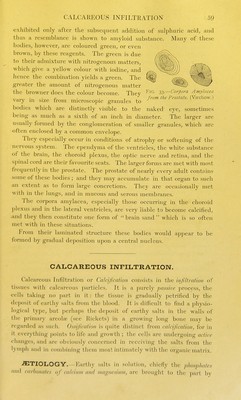
![stao-es^ therefore, there is a considerable resemblance between iodine- stained sections of liver and of spleen, as may be seen by comparing Figs. 29 and 32. In the diffuse form the organ often attains a mucli larger size than is met with in the sago spleen. It is remarkably liard and firm, and the capsule is tense and transparent. On section, it presents a dry, homogeneous, translucent, bloodless surface, of a uniform, dark reddish brown colour. Thin sections can be readily made with a knife, the organ cutting like soft wax. The corpuscles, if affected, are not visible in the former variety, being obscured by the surrounding pulp. Amyloid Degeneration of the Alimentary Canal. The mucous, submucous, and muscular coats of the oesophagus, stomach, and intestines may be involved; but these organs are probably never affected alone. The change frequently co-exists with tubercular ulceration. In the ahmentary tract the disease is very apt to escape observation, as it usually produces but little alteration in the appearance of the parts. The mucous membrane may be jjale, smooth, translucent, and cedematous ; in very advanced cases there may be some rigidity and thickening of the bowel-wall, and even ulcers—due, it has been suggested, to the snapping of rigid villi. The efiFect of the application of iodine to the washed mucous surface is very character- istic. In the small intestine—perhaps the part most commonly affected—small, closely set, reddish brown points appear over the whole surface of the membrane ; these correspond to the intestinal villi, the arteries and capillaries of which have undergone the amyloid change. In the stomach and oesophagus the vessels may be similarly mapped out by iodine (p. 51). The change in the intestine gives rise to serous diarrhoea, probably due to increased permeability of the degenerated vessel-walls. Both absorption and secretion are much impaired, so that implication of the alimentary tract has a grave general effect. Corpora Amylacea. Corpora amylacea or amyloid bodies were formerly looked upon as consisting of amyloid substance; there ajipears, however, with he exception of a certain similarity in their behaviour with iodine and sulphuric acid, to be no connection between them. They are round or oval bodies, formed of a succession of concentric layers, and are often changed to a deep blue colour by iodine, thus bearing, both in structure and chemical ])roperties, a strong resemblance to granules of vegetable starch (Fig. 33); but, sometimes, the blue is](https://iiif.wellcomecollection.org/image/b21503060_0074.jp2/full/800%2C/0/default.jpg)