An introduction to pathology and morbid anatomy / by T. Henry Green.
- Green, T. Henry (Thomas Henry), 1841-1923
- Date:
- 1900
Licence: In copyright
Credit: An introduction to pathology and morbid anatomy / by T. Henry Green. Source: Wellcome Collection.
Provider: This material has been provided by The University of Leeds Library. The original may be consulted at The University of Leeds Library.
88/618 (page 72)
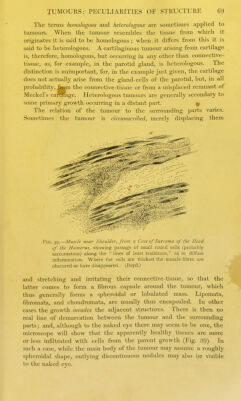
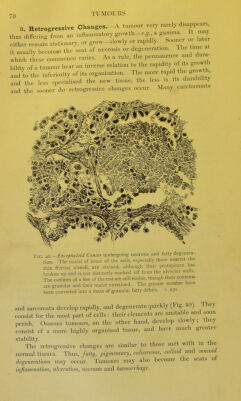
![entiy of some of its elements into the blood-stream. The secondary tumours are, therefore, the result of embohsm of tumour-cells; and are of the same nature as the primary one, although they may be larger and are often softer, more vascular, and more active in growth. They may themselves become secondary centres of infection, and in the same way cause tertiary growths in parts beyond. Althougli the general dissemination of a malignant growth is thus in most cases due to the transmission of its elements by the blood- stream, this is not the only way in which it may be brought about. Exceptional cases have been described in which the elements of a tumour have been distributed and have caused secondary growths in other ways, as by passing down the trachea, between the layers of the peritoneum, or from the kidneys down the ureters to the bladder. Lastly, it must be borne in mind that growths may be secondary to each other only in iime ; that is, they may originate, independently of each other, from different primary foci. We have spoken of generalisation and lymphatic infection as being due to the transference of tumour-cells from the primary growth. Tliat the primary growth is the real source of the secondary growths is shown by their similarity in structure ; by their time-relationship ; by their demonstrable connection by means of blood- or lymph-channels ; by the occasional discovery of tumour-cells impacted in the blood-vessels as emboU; by the invariable absence of secondary growths from non- vascular tissues such as cartilage and cornea; and by the occurrence of secondary growths in tissues in which primary tumours of the structure in question are never found. EFFECTS.—A tumour, by its growth, position, generalisation and secondary changes, may, in many ways, produce marked effects on local and general nutrition. (1) The local growth may lead, mechani- cally, to the destruction of parts essential to life, as in the case of an otherwise innocent tumour in the pons or medulla; or it may similarly impair the action of important organs such as the lungs or stomach, and thus lessen the exchange of gases in the former or interfere with the digestive changes In, or passage of food through, the latter. (2) The rapidity and extent of the growth may lead to the abstraction of the nutriment needed for the maintenance of the normal tissues. (3) Haemorrhage may occur into, or from, a tumour and give rise to anemia, as in the marked hematuria which characterises growths in the kidney. (4) Inflammation, ulceration and septic absorption may occur, as in epithelioma of the tongue. (5) Pain and anxiety may cause anorexia and slee])lessness. (()) Some abnormal and deleterious substances may be discharged into the blood-stream by the tumour- cells, although this is at present a purely hypothetical supposition. (7) Many of these effects may be increased by similar action on the](https://iiif.wellcomecollection.org/image/b21503060_0088.jp2/full/800%2C/0/default.jpg)