Modern dental materia medica, pharmacology and therapeutics : including the practical application of drugs and remedies in the treatment of disease / by J.P. Buckley.
- Buckley, J. P. (John Peter), 1873-1942
- Date:
- [1911], ©1911
Licence: Public Domain Mark
Credit: Modern dental materia medica, pharmacology and therapeutics : including the practical application of drugs and remedies in the treatment of disease / by J.P. Buckley. Source: Wellcome Collection.
613/680 page 543
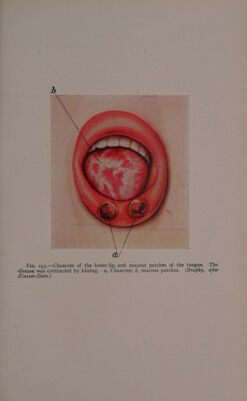
![part should be immediately cauterized. It matters not whether the dentist ever expects to treat a case of syphilis, or not, the menace of the presence of this disease can only be avoided by the careful and intelligent reading of the clinical symptoms. Acquired extragenital syphilis is primarily manifested in and about the soft tissues of the mouth in what is known as the initia] lesion or hard chancre, which, as a rule, develops in from fifteen days to a month after infection. The chancre may occur in various locations—on the lip, tips of the tongue, and the pharynx—and is characteristic of what is known as primary symptoms. Primary Syphilis.—The infection here is produced by direct con- tact of the spirocheta pallida with an abraded surface. According to Logan, the principal means of conveying the infection extragenitally is through the act of kissing, drinking from a broken utensil, the use of a pipe or handkerchief that has been contaminated with the germ, or from physicians’ or dentists’ instruments or fingers that have had the infected secretions from the mouth of a previous patient dried upon them. Diagnosis.—In the locations found in the mouth, chancre is usually single, though it may be multiple (Fig. 193). It may appear — first as a papule, the superficial cells of which finally ulcerate, with necrosis of the central area quickly following, when a copious and highly infectious discharge comes from the crater-like opening that is forming on the tissues involved. The ulceration occurs in from four to ten days after full development of the chancre, until which time the patient, as a rule, experiences very little pain or discomfort. 'Therapeutics.—The treatment of the primary symptoms, until recent years, was considered unimportant. In fact, unless a positive diagnosis could be made, and it is still often difficult to be certain of the clinical diagnosis at this stage of the disease, it was suggested that the treatment be deferred until the diagnosis was established by the manifestations of the secondary symptoms. This has been changed. Ehrlich, the discoverer of salvarsan—or “606,” as it is commonly called, also neosalvarsan the new specific for syphilis, says, ‘‘too much weight cannot be laid upon the importance of diagnosing a syphilitic sore as soon as possible. We should certainly not wait for secondaries to develop or until the Wassermann reaction has become positive. In no period of syphilis is salvarsan more strongly indi- -cated than when the chancre is the sole symptom.” Syphilis is now known to be a germ disease, and the only positive means of confirming the diagnosis of the clinical symptoms in this stage is](https://iiif.wellcomecollection.org/image/b32797345_0613.jp2/full/800%2C/0/default.jpg)