An application to electrolytes of the hydrate theory of solutions / by T. Martin Lowry.
- Martin Lowry
- Date:
- [1905]
Licence: In copyright
Credit: An application to electrolytes of the hydrate theory of solutions / by T. Martin Lowry. Source: Wellcome Collection.
Provider: This material has been provided by The Royal College of Surgeons of England. The original may be consulted at The Royal College of Surgeons of England.
3/12 page 3
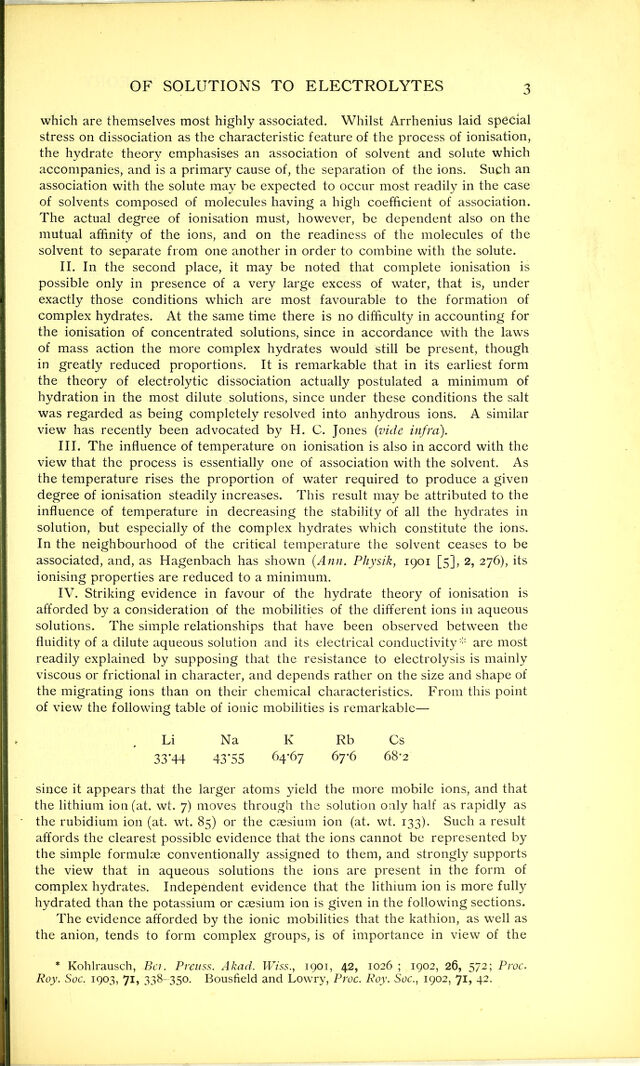
![which are themselves most highly associated. Whilst Arrhenius laid special stress on dissociation as the characteristic feature of the process of ionisation, the hydrate theory emphasises an association of solvent and solute which accompanies, and is a primary cause of, the separation of the ions. Such an association with the solute may be expected to occur most readily in the case of solvents composed of molecules having a high coefficient of association. The actual degree of ionisation must, however, be dependent also on the mutual affinity of the ions, and on the readiness of the molecules of the solvent to separate from one another in order to combine with the solute. II. In the second place, it may be noted that complete ionisation is possible only in presence of a very large excess of water, that is, under exactly those conditions which are most favourable to the formation of complex hydrates. At the same time there is no difficulty in accounting for the ionisation of concentrated solutions, since in accordance with the laws of mass action the more complex hydrates would still be present, though in greatly reduced proportions. It is remarkable that in its earliest form the theory of electrolytic dissociation actually postulated a minimum of hydration in the most dilute solutions, since under these conditions the salt was regarded as being completely resolved into anhydrous ions. A similar view has recently been advocated by H. C. Jones (vide infra). III. The influence of temperature on ionisation is also in accord with the view that the process is essentially one of association with the solvent. As the temperature rises the proportion of water required to produce a given degree of ionisation steadily increases. This result may be attributed to the influence of temperature in decreasing the stability of all the hydrates in solution, but especially of the complex hydrates which constitute the ions. In the neighbourhood of the critical temperature the solvent ceases to be associated, and, as Hagenbach has shown (Ann. Physik, 1901 [5], 2, 276), its ionising properties are reduced to a minimum. IV. Striking evidence in favour of the hydrate theory of ionisation is afforded by a consideration of the mobilities of the different ions in aqueous solutions. The simple relationships that have been observed between the fluidity of a dilute aqueous solution and its electrical conductivity* are most readily explained by supposing that the resistance to electrolysis is mainly viscous or frictional in character, and depends rather on the size and shape of the migrating ions than on their chemical characteristics. From this point of view the following table of ionic mobilities is remarkable— Li Na K Rb Cs 33*44 43*55 64-67 67-6 68-2 since it appears that the larger atoms yield the more mobile ions, and that the lithium ion (at. wt. 7) moves through the solution only half as rapidly as the rubidium ion (at. wt. 85) or the caesium ion (at. wt. 133). Such a result affords the clearest possible evidence that the ions cannot be represented by the simple formulas conventionally assigned to them, and strongly supports the view that in aqueous solutions the ions are present in the form of complex hydrates. Independent evidence that the lithium ion is more fully hydrated than the potassium or caesium ion is given in the following sections. The evidence afforded by the ionic mobilities that the kathion, as well as the anion, tends to form complex groups, is of importance in view of the * Kohlrausch, Bet. Preuss. Akad. Wiss., 1901, 42, 1026 ; 1902, 26, 572; Proc. Roy. Soc. 1903, 71, 338-350. Bousfield and Lowry, Proc. Roy. Soc., 1902, 71, 42.](https://iiif.wellcomecollection.org/image/b22438683_0005.jp2/full/800%2C/0/default.jpg)