An application to electrolytes of the hydrate theory of solutions / by T. Martin Lowry.
- Martin Lowry
- Date:
- [1905]
Licence: In copyright
Credit: An application to electrolytes of the hydrate theory of solutions / by T. Martin Lowry. Source: Wellcome Collection.
Provider: This material has been provided by The Royal College of Surgeons of England. The original may be consulted at The Royal College of Surgeons of England.
4/12 page 4
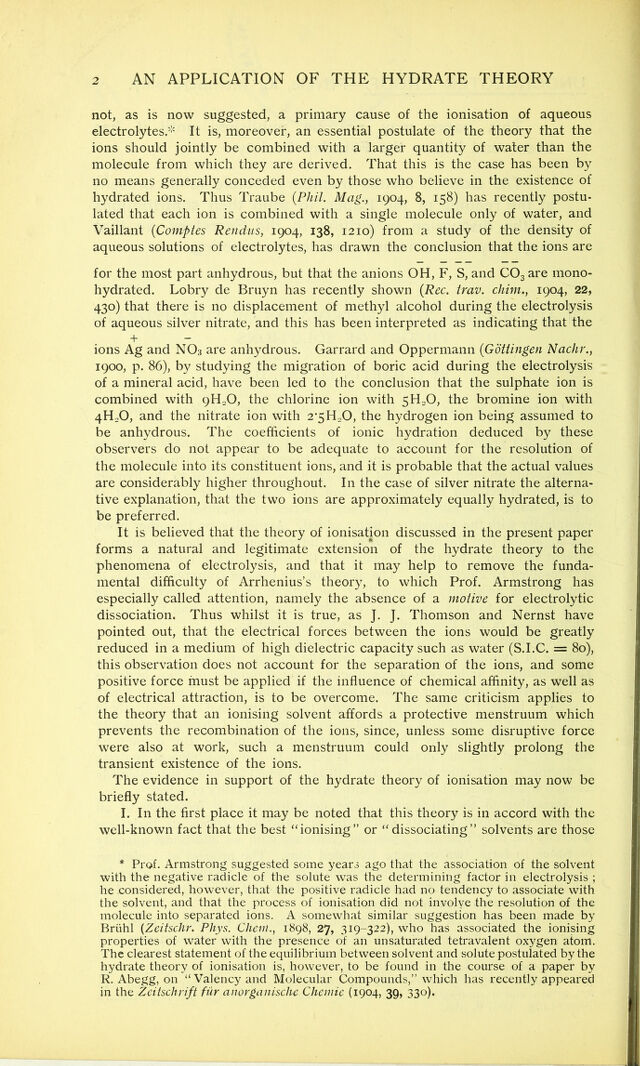
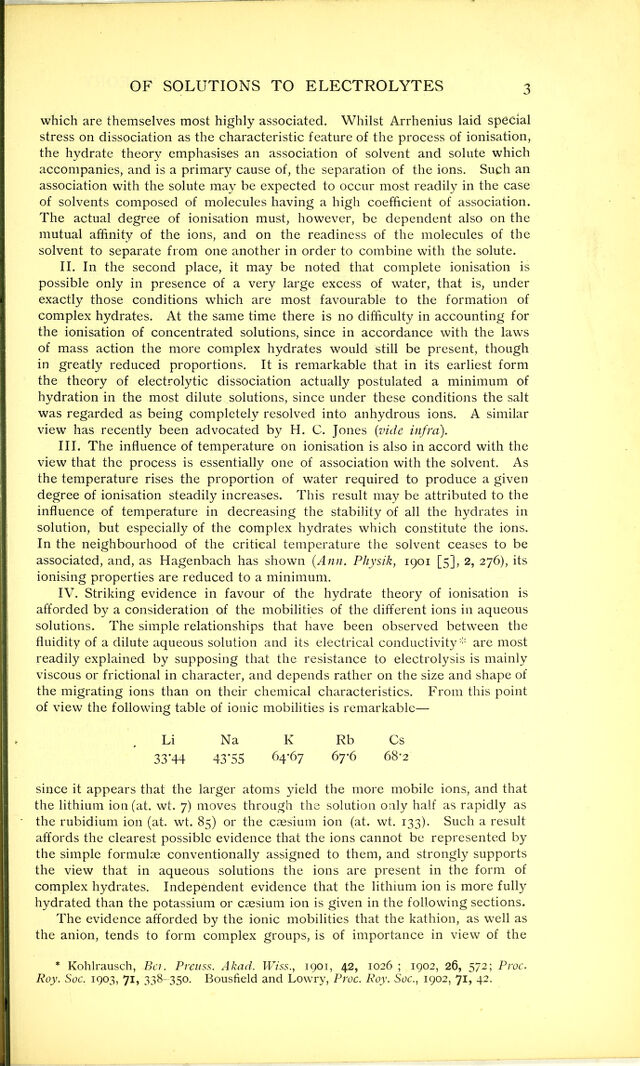
![general tendency to regard the metallic radicles as being almost entirely devoid of residual affinity. V. In the table of ionic mobilities the radicles H and OH occupy an altogether unique position, the mobility of the hydroxyl ion being more than double as great as that of any other anion— OH = 174, [±S04 = 687], Br = 67-63, I = 66-40, Cl = 6544, N03 = 6178, whilst that of the hydrogen ion is nearly five times as great as that of any other kathion :— H =318, Cs = 68-2, Rb = 67-6, T1 = 66*oo, K = 64 67, Ag = 54*02. The peculiar properties of these two ions are most readily explained by supposing that they are either anhydrous or are combined with a smaller proportion of water than any of the other ions. Confirmation of this view is afforded by at least two independent considerations :— (1) The affinity of water molecules for the ions H and OH must be relatively slight, since otherwise liquid water, like fused salt or caustic soda, would be a good electrolyte. Actually, when freed from saline impurities, it forms a most effective insulator. (2) Whereas nearly all sodium and potassium salts are good conductors, the acids from which they are derived vary very greatly in their electrolytic properties, and are often exceedingly poor conductors. This is readily accounted for if it be supposed that in the salts ionisation is brought about by the affinity of the solvent for both anion and kathion, but in the acids mainly by the affinity of the solvent for the anion. Similar considerations may be applied to the bases, which vary in their electrolytic properties far more than the chlorides derived from them. This case is, however, complicated by the fact that the bases have a much greater tendency than the acids to dissociate into water and a neutral anhydride, e.g.— NH4OH = NH3+ HX> Zn (0H)2 = ZnO + H20. VI. Independent evidence in favour of the hydrate theory of ionisation is to be found in a consideration of the freezing-points of dilute aqueous solu- tions. At extreme dilutions the molecular depression of the freezing-point reaches a maximum value corresponding very closely with that required by the theory of electrolytic dissociation. In less dilute solutions, however, values are obtained which cannot be accounted for in terms of this theory as originally propounded. Thus in a large number of cases the molecular depression, which might be expected to decrease continuously with increasing concentration, actually reaches a minimum value between N/ioand N/2, and then increases again with the concentration ; * the molecular conductivity, however, decreases steadily as the concentration increases, and does not reach a minimum value. This result was admirably explained by Jones and Chambers by assuming that “ there is combination between the molecules of the dissolved substances and the molecules of the solvent, thus removing a fart of the solvent as far as the freezing-point lowering is concerned.” No alternative theory has been suggested, and the explanation given is probably correct. Jones and Getman are of opinion that “ it is the molecules and not the ions that combine with water to form hydrates,” j and that “ hydrates of any con- * Arrhenius, Zeit. phys. Client., 1888, 2, 496. Jones and Chambers, Ainer. Client, fount., 1900, 23, 89. Biltz, Zeit. phys. Client., 1902, 40, 185. f Amer. Client, fount., 1904, 31, p. 356.](https://iiif.wellcomecollection.org/image/b22438683_0006.jp2/full/800%2C/0/default.jpg)