An application to electrolytes of the hydrate theory of solutions / by T. Martin Lowry.
- Martin Lowry
- Date:
- [1905]
Licence: In copyright
Credit: An application to electrolytes of the hydrate theory of solutions / by T. Martin Lowry. Source: Wellcome Collection.
Provider: This material has been provided by The Royal College of Surgeons of England. The original may be consulted at The Royal College of Surgeons of England.
6/12 page 6
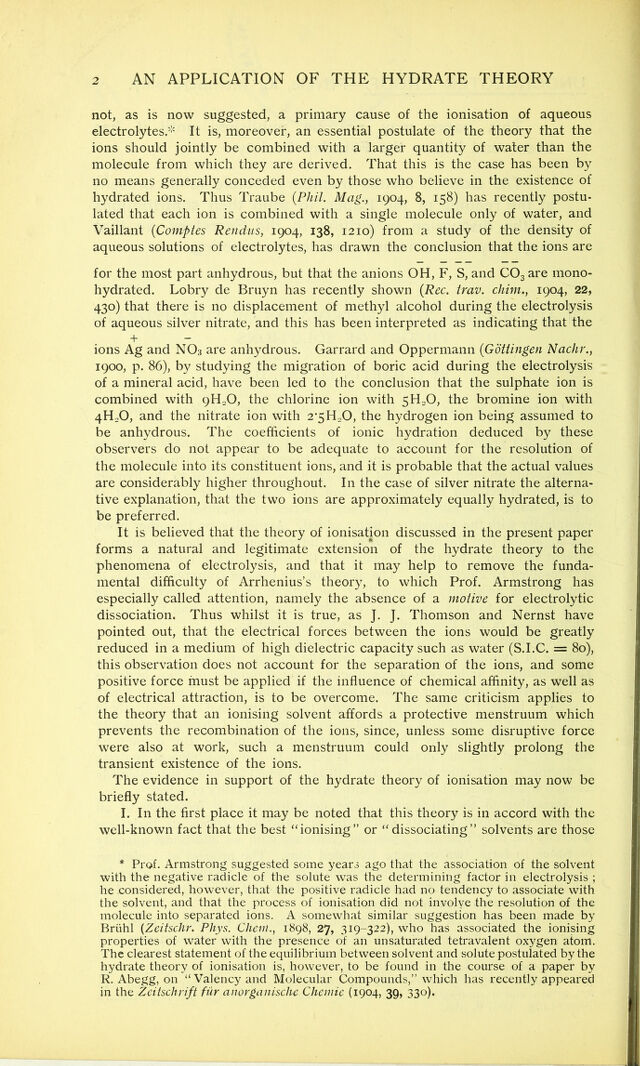
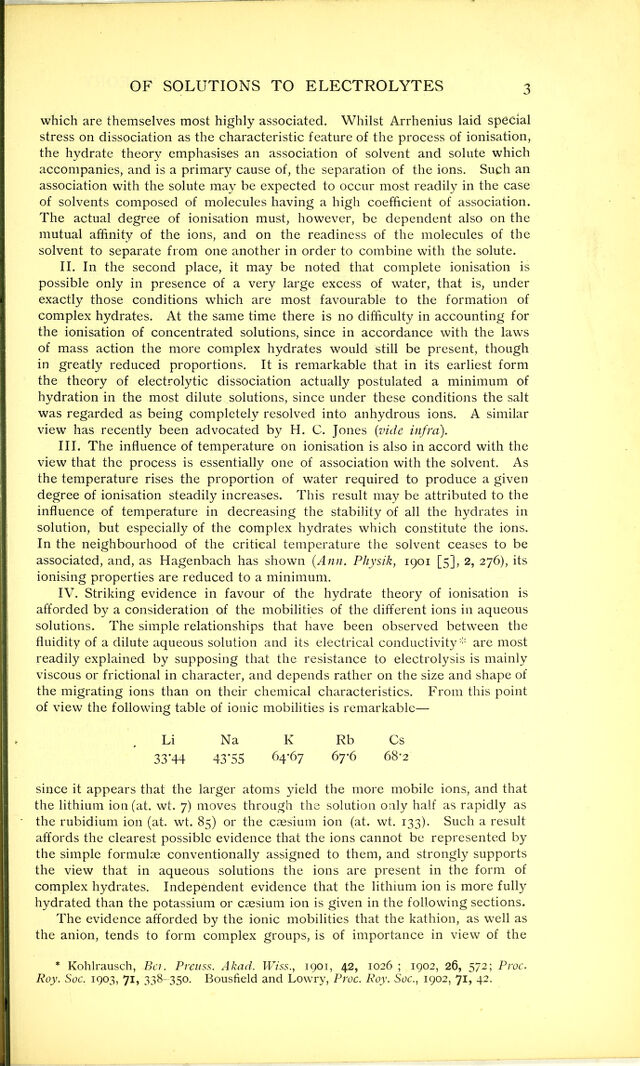
![1000 c.c. of solution may be taken as a first approximation to the actual values. The figures given for aluminium chloride are quoted in column iv. of the table. The authors considered that “ the difference between this amount of water and 1,000 grains was the amount that had combined with one gram-mot ecu Jar weight of the satt under the conditions present in the solution in question,” and proceeded to determine the average molecular hydration by dividing this difference by 18. This method of calculation, the results of which are tabulated in the last column of the table, led to the remarkable conclusion that “ the amount of water combined with one molecule of the dissolved substance is greatest in the most concentrated solutions employed and becomes less and less as the dilution increases” Such a reversal of the normal laws of mass action suggests the existence of some serious flaw in the method used in deducing these values. Two errors appear to have been made, (i) The total weight of water in 1,000 c.c. is not 1,000 grams but a smaller quantity, as is shown in column iii. of the table. (2) The combined water in 1,000 c.c. is com- bined not with one, but with m, gram molecules of the salt. The actual weight of combined water in 1,000 c.c. is given in column v. of the table, and when this is divided by 18 m it gives the average molecular hydration h, shown in column vii. The coefficients of combination j3 = h\H are set out in column viii. The corrected values show a regular increase of molecular hydration as the dilution increases, and are, therefore, in accord with the view that ionisa- tion involves an increase, and not a decrease, in the hydration of the solute. The last three values show an abrupt drop in the molecular hydration, but this is to be attributed rather to the large effects produced in the case of dilute solutions by small experimental errors, than to a sudden reversal of the behaviour observed in more concentrated solutions. TABLE I. Hydration of Aluminium Chloride in Aqueous Solutions. Concen- tration m. Coefficient of Ionisa- tion a. Total Water in i,ooo c.c. W. Solvent Water in 1,000 c.c. W -w. Combined Water in 1,000 c.c. w. Hydra- tion H. Molecular Hydra- tion h. Coefficient of Combina- tion /3. Molecular Hydra- tion (Jones & Getman). 2*124 0*177 9*7 150 767 24*0 20*6 0*84 48*1 *’593 0*237 943 228 7*5 33*o 25*0 078 43*7 r434 0-253 950 253 697 36-9 27*1 0*73 42*0 ri95 0*312 959 33* 628 44*8 29*3 o*66 37*2 0*876 0*388 971 460 5** 6i*6 32-5 o-53 30*0 0*657 o‘435 979 568 411 82*8 34*8 0*42 24*0 o*53i 0*476 983*5 642 34* 103 357 o-35 19*8 0*398 0*529 990 754 236 138 [32-9. 0*24 *37 0*299 0-570 992 872 120 184 [22*3 0*12 7*1 0*200- 0*620 994 942 52 262 [I4'1] 0-05 3*3 A similar investigation of the molecular depressions of the freezing-points has been made by Biltz (Zeitschr. Phys. Chem., 1902, 40, 220). This author found that caesium nitrate (which exhibits a minimum of hydration) behaved in a normal manner, and by assuming that other alkaline salts had a similar coefficient of ionisation he deduced for the molecular hydration of potassium chloride in solutions from N/10 to N/2 the values h = 26 to 15 H20, for sodium chloride h — 25 to 19 H2Q, and for lithium iodide h = 40 H20.](https://iiif.wellcomecollection.org/image/b22438683_0008.jp2/full/800%2C/0/default.jpg)