The myology of the pelvic floor : a contribution to human and comparative anatomy / by Peter Thompson.
- Thompson, Peter, 1871-1921.
- Date:
- 1899
Licence: Public Domain Mark
Credit: The myology of the pelvic floor : a contribution to human and comparative anatomy / by Peter Thompson. Source: Wellcome Collection.
14/166 page 8
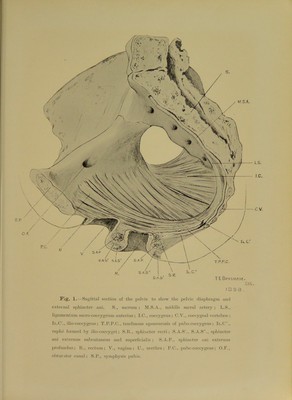
![connective tissue and integument. The muscular fibres, which form a distinct layer in the pelvic floor, surround the canals which traverse the “clefts,” and they control or guard these canals at their outlet; in other words, the layer is largely sphincteric in action. It is obvious that a pelvic floor so constituted is not specially adapted for support. But a great difference in the architecture of the pelvic floor is apparent in those mammals in which the long axis of the body is either absolutely or approximatelv vertical. In them the floor is further modified for the su]Dport of abdominal viscera, and, in addition to the layer of muscle controlling the clefts, another layer is developed in the form of a Avell-marked diaphragm, Avhich constitutes a musculu- sheet attached on all sides to the walls of the ])elvic cavity. In the human subject tills sheet includes the levatores ani and coccygei muscles. Tlie more highly differentiated pelvic floor, therefore, consists of a comjiact mass in which two distinct layers of muscles may be recognised, the arrangement and functions of which are in striking contrast. The upper layer, designed for purposes of support, forms a more or less complete “ pelvic diaphragm ”; the inferior laj’^er, designed for purposes of control, forms sphincters for the openings of the canals ivhich perforate the floor to reach the exterior. Tlie tivo layers are not only functionally but morphologically different. The sphincter muscular layer is derived from the primitive sphincter cloaca?, and though the muscles differentiated from it varj' in the lower and higher types of mammals they follow a general plan of organisation. As regards the pelvic diaphragm it is interesting k) find, that although it contributes to the support of viscera, the muscles Avhich constitute it are derived from the flexors and abductors of the caudal end of the vertebral column. In tailed mammals this group of muscles passes from the side wall of the pelvis to the tail and moves that structure. But coincident Avith the assumption of the upright ])Osture not only is the number of caudal vertelira? reduced but tlio muscles Avhich move them undergo similar retrogressive changes. This group is uoaa' aA'-ailalile for otlier functions, and it cA'entually undergoes sucli modifications as to form (lie diaphragm, aaIucIi is such an essential feature of the pelvic floor in some of the primates.](https://iiif.wellcomecollection.org/image/b28102770_0014.jp2/full/800%2C/0/default.jpg)