Annual medical and sanitary report / Nigeria.
- Nigeria. Medical Department
- Date:
- [1924]
Licence: Public Domain Mark
Credit: Annual medical and sanitary report / Nigeria. Source: Wellcome Collection.
10/146 page 8
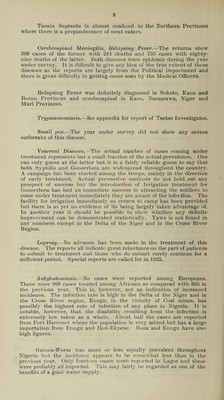
![Taenia Saginata is almost confined to the Northern Provinces where there is a preponderance of meat eaters. Cerebrospinal Meningitis, Eelapsing Fever,—The returns show 390 cases of the former with 244 deaths and 733 cases with eighty- nine deaths of the latter. Both diseases were epidemic during the year under survey. It is difficult to give any idea of the true extent of these diseases as the reports are largely from the Political Department and there is great difficulty in getting cases seen by the Medical Officers. Relapsing Fever was definitely diagnosed in Sokoto, Kano and Bornii Provinces and cerebrospinal in Kano, Nassarawa, Niger and Muri Provinces. Trypanosomiasis.—See appendix for report of Tsetse Investigator. Small pox.—The year under survey did not show any severe outbreaks of this disease. Venereal Diseases.—The actual number of cases coming under treatment represents but a small fraction of the actual prevalence. One can only gness at the latter but it is a fairly reliable guess to say that both Syphilis and Gonorrhoea are widespread throughout the country. A campaign has been started among the troops, mainly in the direction of earh treatment. Actual preventiv^e methods do not hold out any prospect of success but the introduction of Irrigation treatment for Gonorrhoea has had an immediate success in attracting the soldiers to come under treatment immediately they are aware of the infection. The facility for irrigation immediately on return to camp has been provided but there is as yet no evidence of its being largely taken advantage of. In another year it should be possible to show whether any definite improvement can be demonstrated statistically. Yaws is not found in any numbers except in the Delta of the Niger and in the Cross River Region. Leprosy.—No advance has been made in the treatment of this disease. The reports all indicate great reluctance on the part of patients to submit to treatment and those who do submit rarely continue for a sufficient period. Special reports are called for in 1925. Ankylostomiasis.—No cases were reported among Europeans. There were 998 cases treated among Africans as compared with 605 in the previous year. This is, however, not an indication of increased incidence. The infection rate is high in the Delta of the Niger and in the Cross River region, Enugu, in the vicinity of Coal mines, has possibly the highest rate of infection of any place in Nigeria. It is notable, however, that the disability resulting from the infection is extremely low taken as a whole. About half the cases are reported from Port Harcourt where the population is very mixed but has a large importation from Enugn and Ikot-Ekpene. Buea and Enugu have also high figures. Cuiuea-Wo7'm was more or less equally prevalent throughout Nigeria but the incidence appears to be somewhat less than in the previous year. Only fourteen cases were reported in Lagos and these were probably all im])orted. This may fairly be regarded as one of the benefits of a good water supply.](https://iiif.wellcomecollection.org/image/b31490293_0010.jp2/full/800%2C/0/default.jpg)
 No text description is available for this image
 No text description is available for this image
 No text description is available for this image