Fifty-fourth annual report on the health and sanitary condition of the Metropolitan Borough of Islington.
- Islington (London, England). Metropolitan Borough.
- Date:
- 1910
Licence: Attribution-NonCommercial 4.0 International (CC BY-NC 4.0)
Credit: Fifty-fourth annual report on the health and sanitary condition of the Metropolitan Borough of Islington. Source: Wellcome Collection.
20/354 page 12
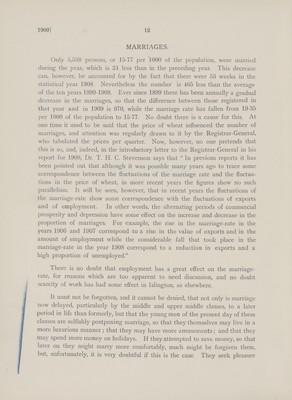
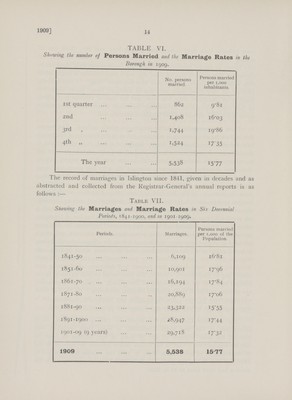
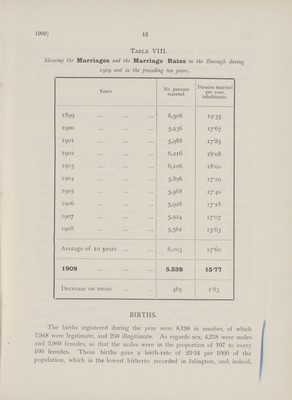
![1909] Vl MARRIAGES. Only 5,53S persons, or 15.77 per 1000 of the population, were married during the year, which is 24 less than in the preceding year. This decrease can, however, be accounted for by the fact that there were 53 weeks in the statistical year 1908. Nevertheless the number is 4G5 less than the average of the ten years 1899-1908. Ever since 1899 there has been annually a gradual decrease in the marriages, so that the difference between those registered in that year and in 1909 is 970, while the marriage rate has fallen from 19.35 per 1000 of the population to 15.77. No doubt there is a cause for this. At one time it used to be said that the price of wheat influenced the number of marriages, and attention was regularly drawn to it by the Registrar-General, who tabulated the prices per quarter. Now, however, no one pretends that this is so, and, indeed, in the introductory letter to the Registrar-General in his report for 1908, Dr. T. H. C. Stevenson says that In previous reports it has been pointed out that although it was possible many years ago to trace some correspondence between the fluctuations of the marriage rate and the fluctua tions in the price of wheat, in more recent years the figures show no such parallelism. It will be seen, however, that in recent years the fluctuations of the marriage-rate show some correspondence with the fluctuations of exports and of employment. In other words, the alternating periods of commercial prosperity and depression have some effect on the increase and decrease in the proportion of marriages. For example, the rise in the marriage-rate in the years 1906 and 1907 correspond to a rise in the value of exports and in the amount of employment while the considerable fall that took place in the marriage-rate in the year 1908 correspond to a reduction in exports and a high proportion of unemployed. There is no doubt that employment has a great effect on the marriage rate, for reasons which are too apparent to need discussion, and no doubt scarcity of work has had some effect in Islington, as elsewhere. It must not be forgotten, and it cannot be denied, that not only is marriage now delayed, particularly by the middle and upper middle classes, to a later period in life than formerly, but that the young men of the present day of these classes are selfishly postponing marriage, so that they themselves may live in a more luxurious manner; that they may have more amusements; and that they may spend more money on holidays. If they attempted to save money, so that later on they might marry more comfortably, much might be forgiven them, but, unfortunately, it is very doubtful if this is the case. They seek pleasure](https://iiif.wellcomecollection.org/image/b18108945_0020.jp2/full/800%2C/0/default.jpg)
 No text description is available for this image
 No text description is available for this image
 No text description is available for this image