Fifty-fourth annual report on the health and sanitary condition of the Metropolitan Borough of Islington.
- Islington (London, England). Metropolitan Borough.
- Date:
- 1910
Licence: Attribution-NonCommercial 4.0 International (CC BY-NC 4.0)
Credit: Fifty-fourth annual report on the health and sanitary condition of the Metropolitan Borough of Islington. Source: Wellcome Collection.
30/354 page 22
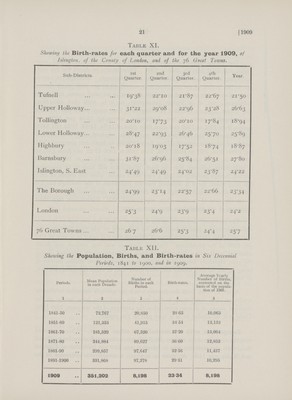
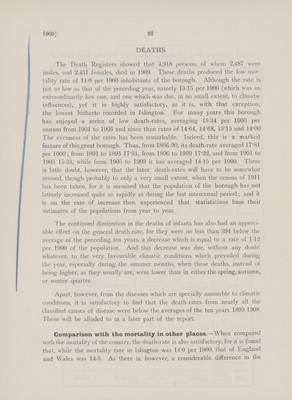
![22 1909] DEATHS. The Death Registers showed that 4,918 persons, of whom 2,487 were males, and 2,431 females, died in 1909. These deaths produced the low mor tality rate of 14.0 per 1000 inhabitants of the borough. Although the rate is not so low as that of the preceding year, namely 13.15 per 1000 (which was an extraordinarily low one, and one which was due, in no small extent, to climatic influences), yet it is highly satisfactory, as it is, with that exception, the lowest hitherto recorded in Islington. For many years this borough has enjoyed a series of low death-rates, averaging 15.34 per 1000 per annum from 1901 to 1905 and since then rates of 14.64, 14.63, 13.15 and 14.00 The evenness of the rates has been remarkable. Indeed, this is a marked feature of this great borough. Thus, from 1886-90, its death-rate averaged 17.81 per 1000; from 1891 to 1895 17.81, from 1896 to 1900 17.22, and from 1901 to 1905 15.34, while from 1905 to 1909 it has averaged 14.15 per 1000. There is little doubt, however, that the later death-rates will have to be somewhat revised, though probably to only a very small extent, when the census of 1911 has been taken, for it is surmised that the population of the borough has not latterly increased quite so rapidly as during the last intercensal period; and it is on the rate of increase then experienced that statisticians base their estimates of the populations from year to year. The continued diminution in the deaths of infants has also had an appreci able effect on the general death-rate, for they were no less than 394 below the average of the preceding ten years, a decrease which is equal to a rate of 1.12 per 1000 of the population. And this decrease was due, without any doubt whatever, to the very favourable climatic conditions which prevailed during the year, especially during the summer months, when these deaths, instead of being higher, as they usually are, were lower than in either the spring, autumn, or winter quarter. Apart, however, from the diseases which are specially amenable to climatic conditions, it is satisfactory to find that the death-rates from nearly all the classified causes of disease were below the averages of the ten years 1899-1908. These will be alluded to in a later part of the report. Comparison with the mortality in other places.—When compared with the mortality of the country, the death-rate is also satisfactory, for it is found that, while the mortality rate in Islington was 14 0 per 1000, that of England and Wales was 14-5. As there is, however, a considerable difference in the](https://iiif.wellcomecollection.org/image/b18108945_0030.jp2/full/800%2C/0/default.jpg)
 No text description is available for this image
 No text description is available for this image
 No text description is available for this image