Fifty-fourth annual report on the health and sanitary condition of the Metropolitan Borough of Islington.
- Islington (London, England). Metropolitan Borough.
- Date:
- 1910
Licence: Attribution-NonCommercial 4.0 International (CC BY-NC 4.0)
Credit: Fifty-fourth annual report on the health and sanitary condition of the Metropolitan Borough of Islington. Source: Wellcome Collection.
34/354 page 26
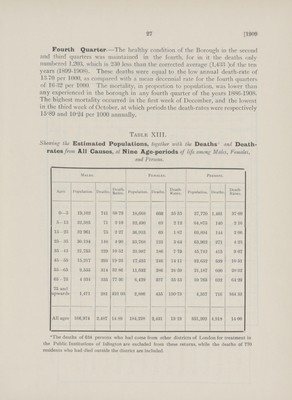
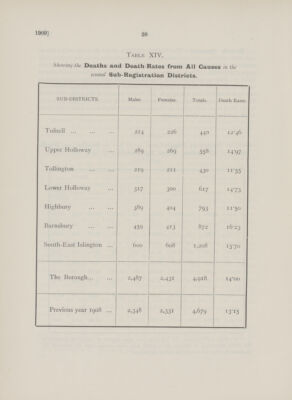
![26 1909] for this quarter of the year of 17.90 per 1000. Thus, the new year did not open very salubriously, nor did it give any indication of the more healthy con ditions which prevailed later on. The highest mortality occurred in the third week of March, and the lowest in the third week of January, at which periods the death-rates were respectively 25.24 and 11.13 per 1000 annually. In the County of London in the same quarter, the death-rate was 19.0, and in the Encircling Boroughs 19.1 per 1000 inhabitants. In St. Pancras it was 20.5; in Stoke Newington 16.4; in Hackney 16.7; in Hornsey 10.2; in Fins bury 26.0; and in Shoreditch 25.4. Second Quarter.— In this quarter there was a decided improvement in the mortality returns, for the deaths only numbered 1,136, or 104 less than the corrected average (1,240) of the ten years (1899-1908), and were equal to the low annual death-rate of 12.93 per 1000, as compared with a mean decennial rate for this quarter of the year of 14.12 per 1000. The mortality, in propor tion to population, was with two exceptions the lowest hitherto experienced in the borough in the second quarters of the years 1886-1908. The highest mortality occurred in the first and second weeks of April, and the lowest in the last week of June, at which periods the death-rates were respectively 17.37, 17.37 and 9.20 per 1000 annually. Third Quarter.—In this quarter the deaths numbered 903, or 295 less than the corrected average (1,198) of the ten years (1899-1908), and were equal to the low annual death-rate of 10.28 per 1000, as compared with a mean decen nial rate of 13.64 per 1000. The mortality, in proportion to population, was lower than any experienced in the borough in the third quarters of the years 1886-1908. The highest mortality occurred in the second week of Sep tember, and the lowest in the first week of September, at which periods the death-rates were respectively 13.06 and 7.27 per 1,000 annually. The excel lent health of the borough at this time was in great part due to the low infantile mortality, for it was found that there were only 180 deaths among infants under a year old, or 177 below the average (357) of the pre ceding ten years at this period of the year. These deaths represented an infantile mortality rate of 90 per 1000 infants born, as compared with 153 per 1000 in the third quarters of the ten years 1899-1908. In the third quarter of 1908 the rate was 95 per 1000 births. The infantile mortality rate was the lowest hitherto recorded for any corresponding period, with one exception, viz.: that of 79 per 1000 in 1907. In the County of London the infantile mortality rate was also low, being only 109 per 1000 births, while in the Encircling Boroughs it was 110. In these the respective infant mortality rates were as follows:—St. Pancras 106, Stoke Newington 97, Hackney 105, Hornsey 50, Finsbury 89, and Shoreditch 179.](https://iiif.wellcomecollection.org/image/b18108945_0034.jp2/full/800%2C/0/default.jpg)
 No text description is available for this image
 No text description is available for this image
 No text description is available for this image