Experiments to ascertain if the domestic fowl of Uganda may act as a reservoir of the virus of sleeping sickness (Trypanosoma gambiense) / by Sir David Bruce, A.E. Hamerton and H.R. Bateman.
- David Bruce
- Date:
- [1911?]
Licence: Public Domain Mark
Credit: Experiments to ascertain if the domestic fowl of Uganda may act as a reservoir of the virus of sleeping sickness (Trypanosoma gambiense) / by Sir David Bruce, A.E. Hamerton and H.R. Bateman. Source: Wellcome Collection.
3/12
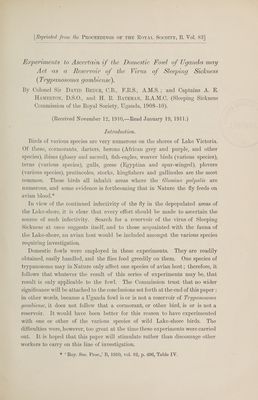
![| Reprinted from the PROCEEDINGS OF THE Royat, Soctery, B, Vol. 83] Hapervments to Ascertain if the Domestic Fowl of Uganda may Act as a Reservoir of the Virus of Sleeping Sickness (Trypanosoma gambiense). By Colonel Sir Davip Brucz, C.B., F.R.S., A.M.S.; and Captains A. E. Hamerton, D.S.0., and H. R. Bateman, R.A.M.C. (Sleeping Sickness Commission of the Royal Society, Uganda, 1908-10). (Received November 12, 1910,—Read January 19, 1911.) Introduction. Birds of various species are very numerous on the shores of Lake Victoria. Of these, cormorants, darters, herons (African grey and purple, and other species), ibises (glossy and sacred), fish-eagles, weaver birds (various species), terns (various species), gulls, geese (Egyptian and spur-winged), plovers (various species), pratincoles, storks, kingfishers and gallinules are the most common. These birds all inhabit areas where the Glossina palpalis are numerous, and some evidence is forthcoming that in Nature the fly feeds on avian blood.* In view of the continued infectivity of the fly in the depopulated areas of the Lake-shore, it is clear that every effort should be made to ascertain the source of such infectivity. Search for a reservoir of the virus of Sleeping Sickness at once suggests itself, and to those acquainted with the fauna of the Lake-shore, an avian host would be included amongst the various species requiring investigation. | Domestic fowls were employed in these experiments. They are readily obtained, easily handled, and the flies feed greedily on them. One species of trypanosome may in Nature only affect one species of avian host; therefore, it follows that whatever the result of this series of experiments may be, that result is only applicable to the fowl. The Commission trust that no wider significance will be attached to the conclusions set forth at the end of this paper : in other words, because a Uganda fowl is or is not a reservoir of 7rypanosoma gambrense, it does not follow that a cormorant, or other bird, is or is not a reservoir. It would have been better for this reason to have experimented with one or other of the various species of wild Lake-shore birds. The difficulties were, however, too great at the time these experiments were carried out. It is hoped that this paper will stimulate rather than discourage other workers to carry on this line of investigation. * ‘Roy. Soc. Proc.,’ B, 1910, vol. 82, p. 496, Table IV.](https://iiif.wellcomecollection.org/image/b33440426_0003.jp2/full/800%2C/0/default.jpg)