On the mammals collected during the 'Skeat expedition' to the Malay peninsula, 1899-1900 / by J. Lewis Bonhote.
- Bonhote, John Lewis James, 1875-1922.
- Date:
- 1900
Licence: In copyright
Credit: On the mammals collected during the 'Skeat expedition' to the Malay peninsula, 1899-1900 / by J. Lewis Bonhote. Source: Wellcome Collection.
Provider: This material has been provided by The Royal College of Surgeons of England. The original may be consulted at The Royal College of Surgeons of England.
3/20
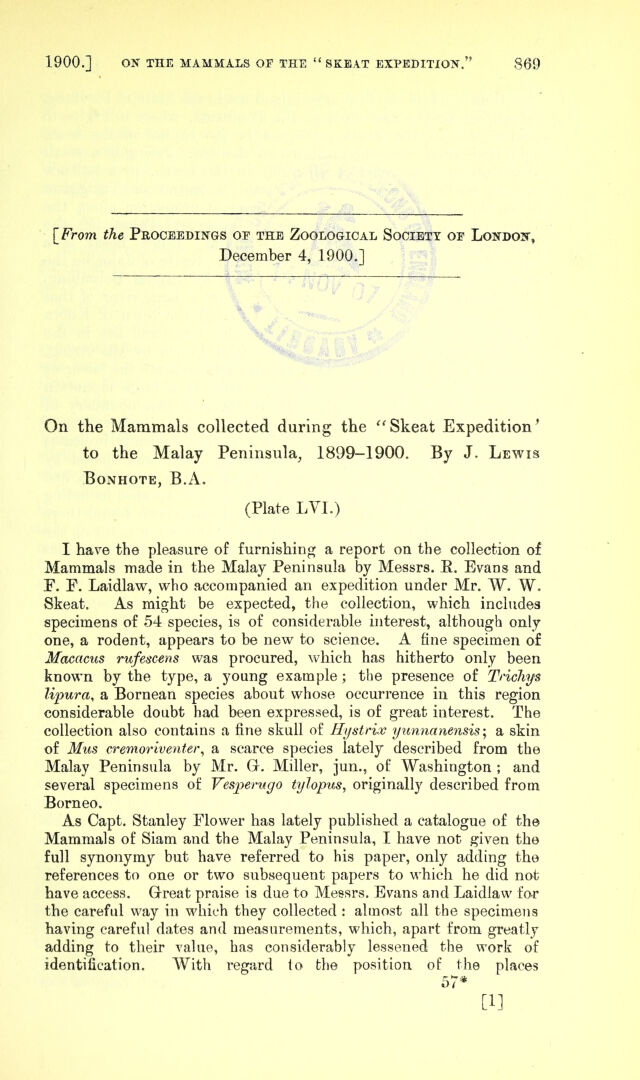
![[From the Proceedings of the Zoological Society of London, December 4, 1900.] On the Mammals collected during the “Skeat Expedition * to the Malay Peninsula, 1899-1900. By J. Lewis Bonhote, B.A. (Plate LVI.) I have the pleasure of furnishing a report on the collection of Mammals made in the Malay Peninsula by Messrs. B. Evans and E. E. Laidlaw, who accompanied an expedition under Mr. W. W. Skeat. As might be expected, the collection, which includes specimens of 54 species, is of considerable interest, although only one, a rodent, appears to be new to science. A fine specimen of Maccicus rufescens was procured, which has hitherto only been known by the type, a young example; the presence of Trichys lipura, a Bornean species about whose occurrence in this region considerable doubt had been expressed, is of great interest. The collection also contains a fine skull of Hystrix yunnanensis; a skin of Mus cremoriventer, a scarce species iately described from the Malay Peninsula by Mr. Gr. Miller, jun., of Washington ; and several specimens of Yesperugo tylopus, originally described from Borneo. As Capt. Stanley Elower has lately published a catalogue of the Mammals of Siam and the Malay Peninsula, I have not given the full synonymy but have referred to his paper, only adding the references to one or two subsequent papers to which he did not have access. Great praise is due to Messrs. Evans and Laidlaw far the careful way in which they collected : almost all the specimens having careful dates and measurements, which, apart from greatly adding to their value, has considerably lessened the work of identification. With regard to the position of the places 57* [1]](https://iiif.wellcomecollection.org/image/b22406499_0005.jp2/full/800%2C/0/default.jpg)