A familiar introduction to the study of polarized light; with a description of, and instructions for using the table and hydro-oxygen polariscope and microscope / [Charles Woodward].
- Woodward, Charles
- Date:
- 1848
Licence: Public Domain Mark
Credit: A familiar introduction to the study of polarized light; with a description of, and instructions for using the table and hydro-oxygen polariscope and microscope / [Charles Woodward]. Source: Wellcome Collection.
32/48 page 28
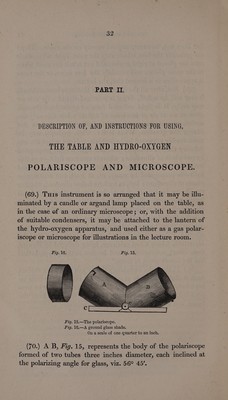
![vided the plates be cut in certain directions, colored rings will be produced, which will change to their complementary colors at every quarter of a revolution of the analyzer. In some instances the rings will be intersected by a cross, which will be black when the axis of the analyzer is at right angles to that of the polarizer, and white when in the same direction ; for in one case the light will be merely stopped, and in the other transmitted. (61.) There is in every doubly refracting crystal at least one direction in which no double refraction takes place, for there must be one line where two opposing forces meet, and neutralize each other: this line is called by some the optic axis, and by others, more intelligibly, the axis of [no] double refraction. If, then, there be any part of a crystal in which double refraction does not occur, the same effect will be produced, when the light transmitted through such part is analyzed, as though no doubly refracting crystal had been interposed, and the light will be merely stopped or transmitted by revolving the analyzer; but as double refraction takes place all around the axis, the systems of waves thus produced will interfere when analyzed, and occasion concentric colored rings. Ifa crystal possess but one axis of [no] double refrac- tion, one system of colored rings, intersected by the effects of the light not doubly refracted, and, consequently, merely stopped or transmitted, will appear: if the crystal have two such axes, two systems will be produced, though in some instances they may be too widely separated to be observed at the same time. (62.) My friend Dr. Pereira has beautifully exemplified this subject in his “ Lectures on Pouarizep Lieut ;” and has shewn that such is the mutual relation existing between the forms and properties of crystals, that the form at once indicates whether or not a crystal possesses the pro- perty of double refraction, and, if a double refractor, whether it has one or two axes of [no] double refraction. To this work I refer those who, having stepped over “the threshold,” are inclined to study the higher branches of this interesting subject.](https://iiif.wellcomecollection.org/image/b29297242_0032.jp2/full/800%2C/0/default.jpg)

 No text description is available for this image
 No text description is available for this image
 No text description is available for this image