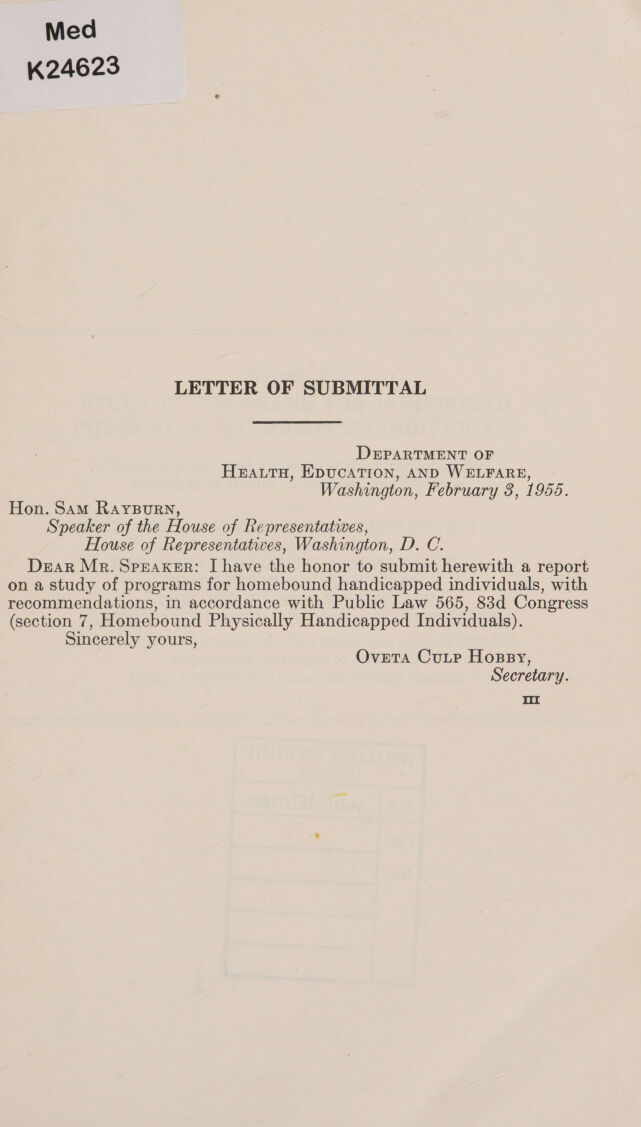
Study of programs for homebound handicapped individuals : Letter from Secretary, Department of Health, Education, and Welfare transmitting a report on a study of programs for homebound handicapped individuals, with recommendations, pursuant to Public Law 565, 83d Congress.
- United States. Department of Health, Education, and Welfare. Vocational Rehabilitation Administration
- Date:
- 1955
Licence: Public Domain Mark
Credit: Study of programs for homebound handicapped individuals : Letter from Secretary, Department of Health, Education, and Welfare transmitting a report on a study of programs for homebound handicapped individuals, with recommendations, pursuant to Public Law 565, 83d Congress. Source: Wellcome Collection.
103/134 page 93
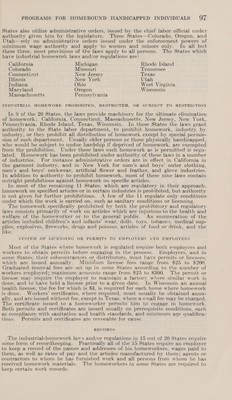
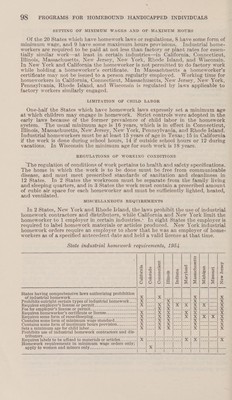
![TABLE C.— Mobility status of recipients of aid to the permar.ently and totally geeabicd, by age group, 30 States, mid-1951 Percentage distribution Mobility status Recipients All ages | Under 35| 35 to 54 | °S and Motalmecipientsas- Se MeL ee hee MOSS aye ae, ae ET 93, 359 100 9.9 36. 4 63.7 Household, totale ty aist-.. 23 ee ee PE 2 eee 19, 350. ay sins Fodoloes hieoagne: aT 054 Hedidaon Velovans Leon h e5)) 5313| 100]. 10) 3681 - 50.2 ON ata ecats a ee Peres eee 5, 829 100 14. 2 38. 2 47.6 Otheny42.... =... SAAR BR ae | 2 8, 208 100 10. 5 37.8 Ola MAQIOLNEL NOCIMIENUS!S 2 5-4 ee ee 73, 973 OTIS, iors 361 Sarr 6 1 Represents 20.7 percent of all recipients of aid to the permanently and totally disabled. 2 Capable of moving about within their homes but not outside. 3 Capable of activity outside home or usual residence. Source: Department of Health, Education, and Welfare, Social Security Administration, Bureau of Public Assistance; Characteristics of Recipients of Aid to the Permanently and Totally Disabled, Mid-1951. Washington, D. C., April 1953. Derived from table 8, p. 21. Taste D.—Mobility status of recipients of aid to the permanently and totally dis- abled, by personal services needed in essentials of daily living, 30 States, mid-1951 Mobility status pat ~. Capable of activity outside All Housebound home or usual residence Personal services needed recip- |——— aces Te a ients ; Bed- | Chai help tae ed- Dair- 3 + elp Total Madea tase Other | Total ae, ofa By self person device Total: Number ofrecipients !__| 98,359 | 19, 350 is e313) 5, 829 8, 208 | 73,973 202 7,198 59, 503 Percent 235 4 St tee 100. 0 100. 0 100. 0 100. 0 100. 0 100. 0 100. 0 100. 0 100. 0 Need for personal services, aC jae POU SF As S| era Ee eee 28. 2 75.4 93. 0 92.1 5200 15.9 79.2 28. 2 6.6 beatin ss seer = Geo ey: 5.9 23.6 46. 0 24.7 8.4 12 7.6 .9 25 nC ReSSin ee = as ee 15.9 do. 2 Cont 74. 3 28.3 5.6 29. 2 10.8 Py AL In toilet functions_____ a 8.9 37.93 74.0 44.2 8.6 15 8.3 2.9 mt In other bodily hygiene MinchHOnSs=2 42> Oo 34. 0 49.7 40.2 19. 4 2k 12541 5.9 LB Incamibulatine <= <--s-= 11.0 36. 5 29.4 64. 4 21.4 4.3 34. 5 8.3 Bw In activities affecting persona] safety __----_- 15. 4 35. 3 36. 4 41.6 30. 2 10. 2 53.8 14.2 4.4 Noneedfor theseserviees..| 7h8| 246) .7.0| | 7.9|-247.7|. 841) -20.8..7181 93.4 1 Includes a few recipients whose mobility status was not reported and a few for whom data as to need for personal services were not reported. 2 Based on data excluding those recipients for whom mobility status and need for personal services were not reported. 3 Less than sum of entries for each type of service because some recipients needed more than one type. Source: Department of Health, Education, and Welfare, Social Security Administration, Bureau of Pub- lic Assistanee, Characteristics of Recipients of Aid to the Permanently and Totally Disabled, Mid-1951. Was ington, D:; G, , April 1953. Table 11, p. 25.](https://iiif.wellcomecollection.org/image/b32173593_0103.jp2/full/800%2C/0/default.jpg)