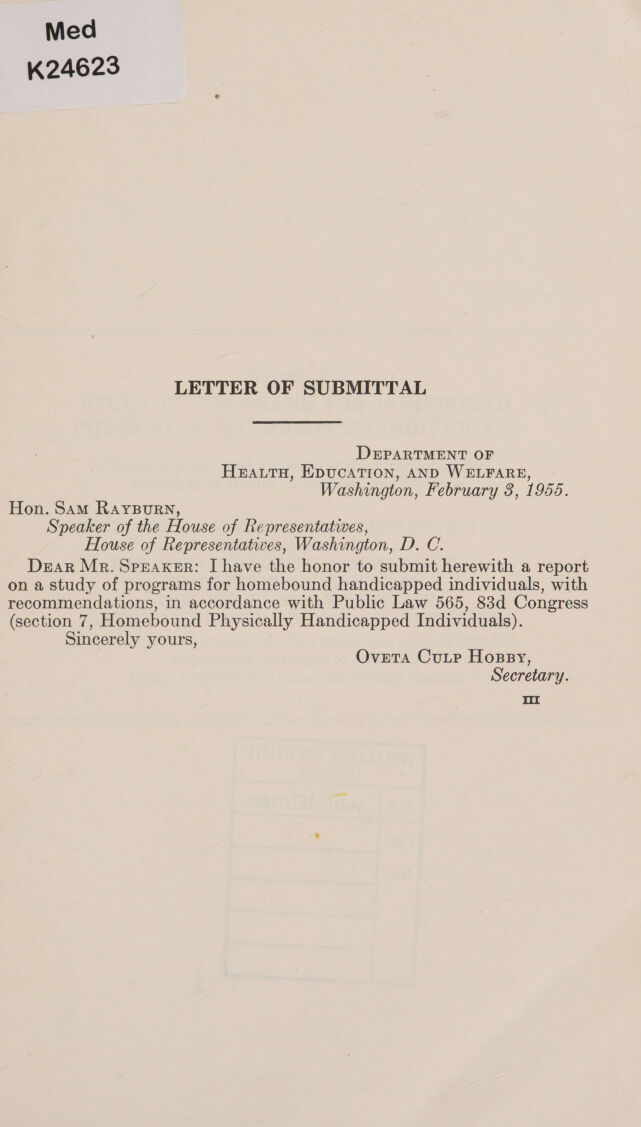
Study of programs for homebound handicapped individuals : Letter from Secretary, Department of Health, Education, and Welfare transmitting a report on a study of programs for homebound handicapped individuals, with recommendations, pursuant to Public Law 565, 83d Congress.
- United States. Department of Health, Education, and Welfare. Vocational Rehabilitation Administration
- Date:
- 1955
Licence: Public Domain Mark
Credit: Study of programs for homebound handicapped individuals : Letter from Secretary, Department of Health, Education, and Welfare transmitting a report on a study of programs for homebound handicapped individuals, with recommendations, pursuant to Public Law 565, 83d Congress. Source: Wellcome Collection.
16/134 page 6
![persons who were homebound. Of interest, however, was the finding that in the population surveyed by the Committee about 3 persons in each 1,000 were reported as disabled throughout the study year, excluding those in institutions. Disability, according to the study, meant that because of some physical or mental condition, an indi- vidual was unable to carry on his usual duties, such as working, going to school, or keeping house. The Committee’ s figure of 3 per 1,000 is considerably lower than that found in the National Health Survey, conducted a number of years later. | National health survey—During 1935-36, the national health survey ° was conducted by the Public Health Service to determine the number and characteristics of persons in the urban population, with disabling illness or with some chronic disease or impairment, whether or not disabling. Despite the great volume of material obtained re- lating to disability, the National Health Survey provided no data pertaining directly to the homebound. Nearest to information of this kind were the data obtained on the so-called invalid population of the Nation. Invalids were described by the study as persons who, because of disease, accident, or physical or mental impairment, were unable to work, go to school, keep house, or carry on their other usual activi- ties for a full 12 months preceding the survey visit. In the surveyed population, 11.7 out of each 1,000 were reported to be in this invalid group.* If this same rate were applicable today, and applied equally to urban and rural areas, the invalid population might fall just short of 2 million persons. Unfortunately, the propor tion of invalids confined to their homes is not known from the national] health survey. Without doubt some of those reported as ‘invalids’ were able to engage in activities outside the home. Disability surveys, February 1949 and September 1950.—Since the time of the national health survey, only one known attempt has been made to determine the extent of disability in the United States. In February 1949 and in September 1950, the Census Bureau’s current population survey obtained data on the prevalence and duration of disability.© Survey findings related to the civilian noninstitutional population 14 to 64 years of age. While the survey results did not provide guides for estimating the homebound population, the Septem- ber 1950 study did provide data on the number of persons who had been disabled for a year or longer. On the day of the survey in September 1950, nearly 2 million persons 14 to 64 years of age and not in institutions had been disabled for at least a full year.6 Of 3 During the winter of 1935-36, the Public Health Service conducted an inquiry into the state of the Nation’s health by means of a house-to-house canvass in 88 cities in 18 States. The 83 cities were selected so as to be representative in general of cities in the United States according to region and size. A total of 2,502,391 individuals in 703,092 households were included in the sample, An additional 36,801 households, including 140,418 persons were surveyed in 23 rural counties in 3 States. Data from the rural sample, how- ever, were not included in the tabulations on invalidism. Source of data: Britten, Rollo H.; Collins, Selwyn D., and Fitzgerald, James S. The National Health Survey: Some General Findings as to Disease, Accidents, and Impairments in Urban Areas. Public Health Reports, March 15, 1940, Reprint No. 2148, 27 pages. (See pp. 16-17.) 4 Persons in institutions for the care of physical or mental diseases were not directly enumerated in the survey, although the family was asked to report such persons. Reports obtained were so incomplete that the data are considered to relate to the noninstitutional population only. 5 Hach month the Bureau of the Census conducts a current population survey that provides, on a sample basis, national statistics on employment and unemployment. Although designed primarily to produce current statistics on the labor force, it is frequently used for making special surveys for a wide variety of purposes. In February 1949 and in ‘September 1950, as a joint project. of the Social Security Administration, the Public Health Service, and the Office of Vocational Rehabilitation, questions on disability were added to the survey schedule. ‘As used in the study, disabled persons are those who, on the day of the survey, were unable to do their regular work or other duties because of disease or injury, as well as those who had a long-term physical or mental condition that allowed them to work only occasionally or not at all. 6 Unpublished data. Office of Vocational Rehabilitation.](https://iiif.wellcomecollection.org/image/b32173593_0016.jp2/full/800%2C/0/default.jpg)