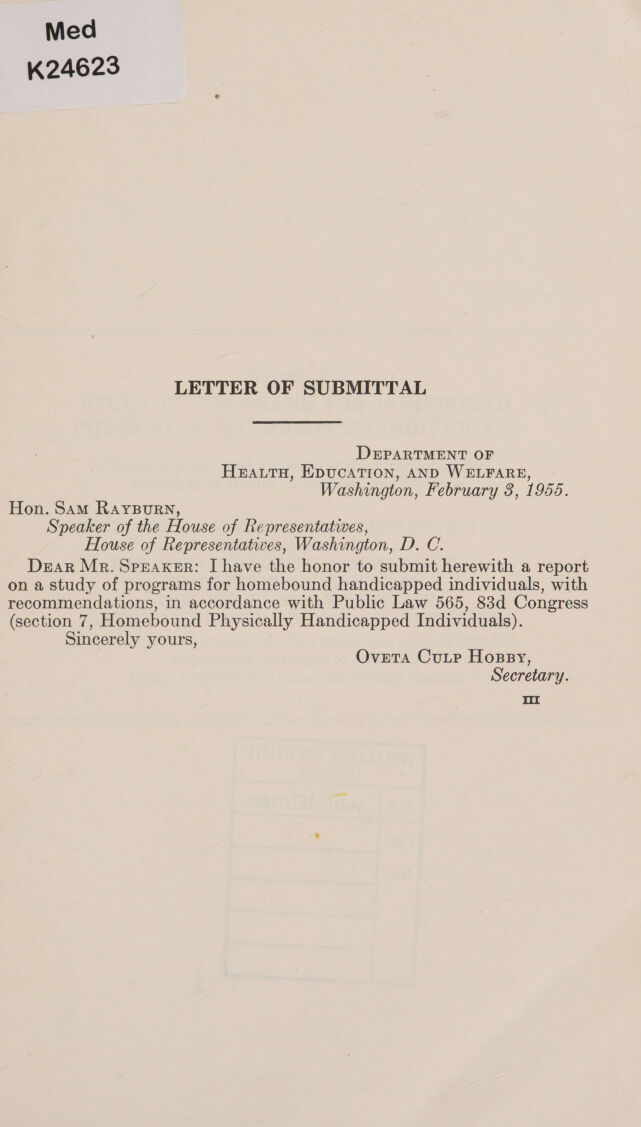
Study of programs for homebound handicapped individuals : Letter from Secretary, Department of Health, Education, and Welfare transmitting a report on a study of programs for homebound handicapped individuals, with recommendations, pursuant to Public Law 565, 83d Congress.
- United States. Department of Health, Education, and Welfare. Vocational Rehabilitation Administration
- Date:
- 1955
Licence: Public Domain Mark
Credit: Study of programs for homebound handicapped individuals : Letter from Secretary, Department of Health, Education, and Welfare transmitting a report on a study of programs for homebound handicapped individuals, with recommendations, pursuant to Public Law 565, 83d Congress. Source: Wellcome Collection.
42/134 page 32
![such programs were operated by its affiliates. Services include the mobile speech and hearing clinic of the North Dakota chapter, and the mobile therapy unit of the Florida Society for Crippled Children. The former provides such specific services as testing for speech dis- orders and hearing defects, referrals, and consultations; in the latter, an occupational and physical therapist provided instruction to the parents of handicapped children in procedures for carrying out certain treatments at home. Although such mobile units are now used primarily with children, adaptation of the method for increasing rehabilitation services for homebound adults is being given consideration. Similar mobile units to furnish home treatment for patients with arthritis have been estab- lished by the State and local affiliates of the Arthritis and Rheuma- tism Foundation, for example, in Arizona, northern California, Michi- gan, the District of Columbia, and elsewhere.2! Mobile units both for arthritics and for crippled children have been developed more extensively in Canada than in this Nation. In its recently published report to the members-elect of the 1955 General Assembly of the State of Vermont, the Vermont Commission on the Chronically Ill and Aged recommended the establishment of one modern rehabilitation center in Vermont and further recom- mended that— A modern rehabilitation center, wherever located, should be organized and equipped to make periodic visits to those general hospitals where there are smaller counterparts of the major center. _ The personnel of this traveling clinic would act as consultants in specialized fields and would advise on special problem cases. Progressively this team could help to formulate wider rehabilitation services in the local hospitals as the efficacy of the service became demonstrated.” Self-help devices —The growing use of mechanical devices to reduce the amount of energy an individual must expend has particular impli- cations for persons with physical disability, many of whom have lost all or a part of their ability to perform the functional activities of daily living. Recognizing these implications, professional workers, the families and friends of the disabled, and the disabled themselves, have produced more and more “self-help” devices within recent years, designed to assist the disabled in performing some functional activities in daily living which could not be performed without mechanical assistance. With a grant from the National Foundation for Infantile Paralysis, the Institute of Physical Medicine and Rehabilitation, New York University-Bellevue Medical Center, New York City, has been engaged for the past 5 years in the evaluation and clinical testing of such devices, the development of new devices, and the dissemination of information concerning self-help devices to professional workers in rehabilitation and to the public.” In cooperation with the New York Chapter, Arthritis and Rheuma- tism Foundation, the Institute of Physical Medicine and Rehabilita- tion has published a special publication on Self-Help Devices for the Arthritic.”* Home management aids.—Of considerable value to many homebound persons is the research and development work done by various groups 31 Mobile Physiotherapy Units, Chronic Illness Newsletter, vol. 3, No. 6, pp. 2-8. August-September 1952 2 Summary of the Interim Study Made by the Commission on the Chronically Il] and Aged to the Members-Elect of the 1955 General Assembly of the State of Vermont, p. 25. lame Howard A., M. D., and Taylor, Eugene J., Living With a ‘Disability, New York: Doubleday and Co., 1953. 24 Lowman, Edward W., M. D., Self-Help Devices for the Arthritic, Rehabilitation Monograph VI, New York: The Institute of Physical Medicine and Rehabilitation, 1954.](https://iiif.wellcomecollection.org/image/b32173593_0042.jp2/full/800%2C/0/default.jpg)