Essentials of pathology and morbid anatomy / by C.E. Armand Semple.
- Semple, C. E. Armand (Charles Edward Armand), 1845-1895
- Date:
- 1889
Licence: Public Domain Mark
Credit: Essentials of pathology and morbid anatomy / by C.E. Armand Semple. Source: Wellcome Collection.
158/188 (page 136)
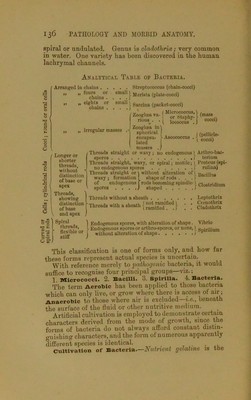
![spiral or undulated. Genus is cladothrix; very common in water. One variety has been discovered in the human lachrymal channels. Analytical Table of Bacteria. O u 1 3 Arranged in chains „ „ fours or chains . eights or chains . . . . Streptococcus (chain-cocci) small) jjerj6ta (plate-cocci) small 1 gajpjaa (packet-cocci) irregular masses .- „ 1 , ( Micrococcus,) S»“ —I &»}*=* Asoococcus ((pellicle* ' t eocci) £ 2 <3 O to Longer or shorter threads, without distinction of base or apex Threads, showing distinction of base V and apex Spiral threads, flexible or Btiff Zoogioea in' spherical encapsu- lated masses . r Threads straight or wavy; no endogenous 1 Arthro-bac- spores 1 terium Threads straight, wavy, or spiral; motile; t Proteus (spi- no endogenous spores ) rulina) Threads straight or I without alteration of 1 Tjacill'is wavy ; formation ! shapo of rods . . . ) u of endogenous ( rods becoming spindle- ] spores Threads without a sheath Leptothrix ... , . (not ramified 1 . . Crenotlirix Threads with a sheath {ramifled _[ _ . cladothrix i [ rods becoming spindle-1 closlridium .) shaped ) Endogenous spores, with alteration of shape. Vibrio Endogenous spores or arthro-spores, or none, 1 gpirmura without alteration of shape J F This classification is one of forms only, and bow far these forms represent actual species is uncertain. With reference merely to pathogenic bacteria, it would suffice to recognise four principal groups—viz.; 1. Micrococci. 2. Bacilli. 3. Spirilla. 4. Bacteria. The term Aerobic has been applied to those bacteria which can only live, or grow where there is access of air; Anaerobic to those where air is excluded—i.e., beneath the surface of the fluid or other nutritive medium. Artificial cultivation is employed to demonstrate certain characters derived from the mode of growth, since the form8 of bacteria do not always afford constant distin- guishing characters, and the form of numerous apparently different species is identical. . cultivation of Bacteria.—Nutrient gelatine is the](https://iiif.wellcomecollection.org/image/b28112805_0158.jp2/full/800%2C/0/default.jpg)