Articles from "The reference handbook of the medical sciences" (William Wood & Co., New York, third edition, 1914) / by C. Judson Herrick.
- Charles Judson Herrick
- Date:
- [1914?]
Licence: In copyright
Credit: Articles from "The reference handbook of the medical sciences" (William Wood & Co., New York, third edition, 1914) / by C. Judson Herrick. Source: Wellcome Collection.
26/44 page 720
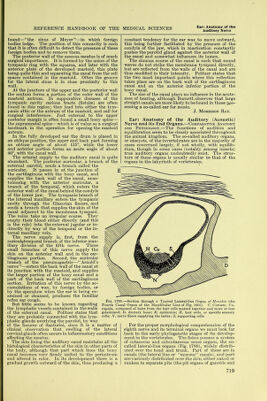
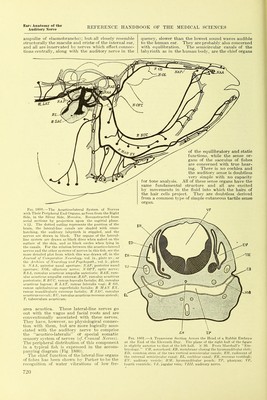
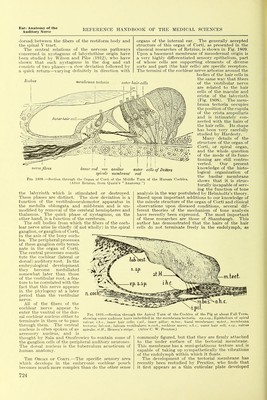
![Auditory Nerve REFERENCE HANDBOOK OF THE MEDICAL SCIENCES ampulliB of elasmobranchs); but>all closely resemble structurally the maculae and cristae of the internal ear, and all are innervated by nerves which effect connec- tions centrally, along with the auditory nerve in the quency, slower than the lowest sound waves audible to the human ear. They are probably also concerned with equilibration. The semicircular canals of the labyrinth as in the human body, are the chief organs of the equilibratory and static functions, while the sense or- gans of the sacculus of fishes are concerned with true hear- ing. There is no cochlea and the auditory sense is doubtless very simple with no capacity for tone analysis. All of these sense organs have the same fundamental structure and all are excited by movements in the fluid into which the hairs of the hair cells ]jroject. They are doubtless derived from a common type of simple cutaneous tactile sense organ. Fig. 1800.—The Acuetico-lateral System of Nerves with Their Peripheral End Organs, as Seen from the Right Side, in the Silver Side, Menidia. Reconstructed from serial sections by projection upon the sagittal plane. X 12. The dotted outline represents the position of the brain, the lateral-line canals are shaded with cross- hatching, the auditory labyrinth is stippled, and the nerves are drawn in black. The organs of the lateral- line system are drawn as black discs when naked on the surface of the skin, and as black circles when lying in the canals. For the relation between the acustico-latera 1 nerves and the other systems of nerves in this fish, see the more detailed plot from which this was drawn off, in the Journal of Comparative Neurology, vol. ix., plate xv., or the Archives of Neurology and Psychopath., •vol. i\., plate ii. NAA, anterior nasal aperture; NAP, posterior nasal aperture: NOL, olfactory nerve; N OPT, optic nerve; RAA, ramulus acusticus ampullre anterioris; RAE, ram- ulus acusticus ampullae externae; i?AP, ramulus acusticus posterioris; R BUC, ramus buccalis facialis; RL, ramulus acusticus lagense; R LAT, ramus lateralis vagi: R OS, ramus ophthalmicus superficialis facialis; R MAN EX, ramus mandibularis externus facialis: R SAC, ramulus acusticus sacculi; R U, ramulus acusticus recessus utriculi; T, tuberculum acusticum. area acustica. These lateral-line nerves go out tvdth the vagus and facial roots and are conventionally associated with these nerves. They have, however, no physiological connec- tion tvith them, but are more logically asso- ciated with the auditory nerve to comprise the “acustico-lateralis” or special somatic sensory system of nerves (c/. Cranial Nerves). The peripheral distribution of this component in a typical fish is expressed in the accom- panying diagram (Fig. 1800). The chief function of the lateral-line organs of fishes has been shown by Parker to be the recognition of water vibrations of low fre- 720 Fig. 1801.—A Transverse Section Across the Head of a Rabbit Embryo at the End of the Eleventh Day. The plane of the right half of the figure is slightly anterior to that of the left half. X 30. From Marshall’s Em- bryology.” CH, notochord; EB, membrane closing the hyomandibular cleft; ED, common stem of the two vertical semicircular canals; Eli, rudiment of the external semicircular canal: EL, cochlear canal: ER, recessus vestibuli; EV, auditory vesicle; IIM, hyomandibular pouch; TP, jiharynx; VF, fourth ventricle; VJ, jugular vein; VIII, auditory nerve.](https://iiif.wellcomecollection.org/image/b28132701_0026.jp2/full/800%2C/0/default.jpg)


 No text description is available for this image
 No text description is available for this image
 No text description is available for this image