[Report 1918] / Medical Officer of Health, Luton County Borough.
- Luton (England). County Borough Council.
- Date:
- 1918
Licence: Attribution 4.0 International (CC BY 4.0)
Credit: [Report 1918] / Medical Officer of Health, Luton County Borough. Source: Wellcome Collection.
6/36 page 4
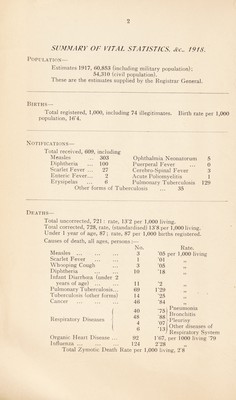
![Statistics for the Year 1918, K summary of these will be found on p. 2, to be compared with those of 1917, given on p. 3. The figures for estimated population are still supplied by the Registrar General, the higher figure including the military population, to be used when calculating the birth rate, whilst the lower (civilian population on]}^ is for use in estimating the death rate. Birth Rate and Infant Death Rate. The birth rate has declined still further than in the previous year. Fortunately the infant death rate also remains low. The latter-is now practically stationary, at 87 per 1,000, compared with 86'5 per 1,000 in 1917. Notifications of Infectious Disease. In this respect, matters are very satisfactory, as the number of notifications for 1918 was only 609, com¬ pared with 1196 in 1917, and 819 in 1916. This low figure is due to the fact that Measles was not prevalent to any serious extent during the year, and also to the small number of cases of Diphtheria and Scarlet Fever as compared with other years. Death Returns. The deaths for 1918 numbered 728 compared with 640 in 1917, an increase of 88, which is easily accounted for by the fact that Influenza was responsible for 124 deaths in this Borough. A comparison of pages 2 and 3, shows that Bronchitis has been responsible for an increased number of deaths this year, which is accounted for by the fact that catarrhal conditions of the lungs were very common at the time of the epidemic. Fuller discussion of the above matters, and other details, will be found in the text of the report. After-War Problems of Public Health, The problems awaiting public health authorities of the country, now that the great war is over, are many and varied. A question which excites universal interest, and which is of far reaching importance, is the problem of a low birth rate. In times of economic stress this condition is inevitable and will probably be righted again in times of peace and prosperity, but it will not be surprising if the birth rate remains low for several years. If such conditions obtain, it becomes increasingly important to keep down the death rate, particularly the infant death rate, and the death rate of children up to the age of 5 years. During the last twenty years the infant death rate of this Borough has been more than halved (from 190 to 90), but during the next 5 years it should be halved again, or reduced to at least 50 per 1,000. The establishment of Municipal Maternity Homes is a measure which is calculated to reduce infant mortality, and in addition, by removing some of the difficulties attendant on the process of childbirth, it may have the effect of encouraging a higher birthrate. Another matter which is exciting considerable interest, at present, is the question of ‘‘painless” methods of childbirth. In recent years much progress has been made in the improvement of the technique of these methods, par¬ ticularly witj^i the Scopolamine-morphine method. This method, as conducted in special institutions devoted to the purpose, involves practically no additional risk, either to mother or child.](https://iiif.wellcomecollection.org/image/b29746772_0006.jp2/full/800%2C/0/default.jpg)