[Report 1944] / Medical Officer of Health, Birkenhead County Borough.
- Birkenhead (England). County Borough Council.
- Date:
- 1944
Licence: Attribution 4.0 International (CC BY 4.0)
Credit: [Report 1944] / Medical Officer of Health, Birkenhead County Borough. Source: Wellcome Collection.
16/61 page 13
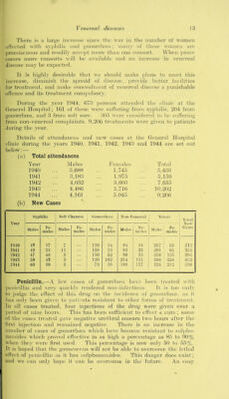
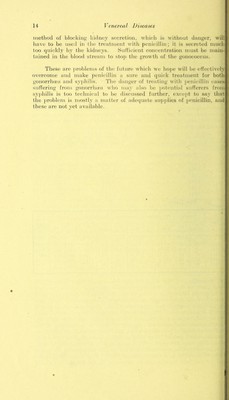
![H There is a large increase since the war in the number of women affected w'ith syphilis a.nd gonorrlicea; many of these women are ■ promiscuous and readily accept more than one consort. When peace -comes more consorts will be available and an increase in venereal disease may be expected. It is highly desirable that we should make plans to meet this increase, diminish the S])rea\d of disease, provide l^etter facilities for treatment, and make concealment of venereal disease a punishable offence and its treatment compulsory. During the year 1944, 673 persons attended the clinic at the ' General Hosjjital; 161 of these were suffering from syphilis, 204 from gonorrhoea, and 3 from soft sore. 305 were considered to be suffering ' from non-venereal complaints. 9,206 treatments were given to patients during the year. Details of attendances and new cases at the General Hospital clinic during the years 1940, 1941, 1942, 1943 and 1944 are set out below:-— (a) Total attendances Year Males Females Total 1940 3,688 1,745 5,433 1941 3,183 1,975 5,159 1942 4,052 3,603 7,655 1943 4,486 5,716 10,202 1944 4,161 5,045 9,206 (b) New Cases Year Syphilis Soft Chancre Gonorrlnea Non-Venereal Totals ■ ! Total New Cases Males Fe- males Males Fe- males Males Fe- males Males Fe- males Males 1 Fe- males 1940 46 17 7 110 14 94 24 257 55 312 1941 49 23 11 — 138 13 93 25 291 61 352 1942 47 48 3 — 110 52 99 35 259 135 394 1943 59 43 3 __ 120 102 214 111 396 256 652 1944 60 39 3 — 73 5(5 188 117 324 212 536 Penicillin.—A few cases of gonorrhoea have been treated witli penicillin and very quickly rendered non-infections. It is too early to judge the effect of this drug on the incidence of gonorrhoea, as it has only been given to patients resistant to other forms of treatment. In all cases treated, four injections of the drug were given over a period of nine hours. This has been sufficient to effect a cure; some of the cases treated gave negative urethral smears two hours after the first injection and remained negative. There is an increase in the number of cases of gonorrhoea which have become resistant to sulpho- namides which proved effective in as high a percentage as 85 to 90% when they were first used. This percentage is now only 50 to 55%. It is hoped that the gonococcus will not be able to overcome the lethal effect of penicillin as it has sulphonamides. This danger does exist; and we can only hope it can be overcome in the future. An easy](https://iiif.wellcomecollection.org/image/b28927382_0017.jp2/full/800%2C/0/default.jpg)