Licence: Public Domain Mark
Credit: Annual sanitary report of the Province of Assam. Source: Wellcome Collection.
50/52 page 2
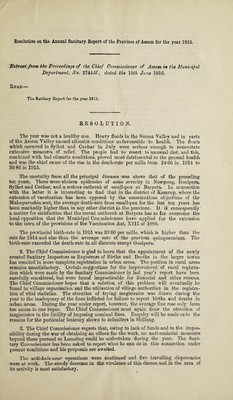
![4. The Chief Commissioner is glad to learn that, although funds were not avail¬ able as freely as they have been in the past, considerable improvement in urban sanitation were effected during the year. He recognises that the Sanitary Department has an uphill task in dealing with many of our municipalities. Active and passive obstruction has to be fought and Municipal Commissioners and Chairmen persuaded to action which they know is required, but which they are for various reasons reluct¬ ant to take. The Sanitary Commissioner’s remarks regarding the failure of most municipalities to insist on the adoption of a sanitary pattern of latrine are strongly worded. It is however obvious that the insistence on a cleansabie pattern of latrine is the first essential to a satisfactory conservancy system; and, now that type plans of a cheap and sanitary pattern are at their disposal, municipalities have no excuse for postponing this elementary and most important reform. The activity of the Jorhat Municipality under the chairmanship of Lieutenant-Colonel A. Playfair is in this respect in marked contrast to the inaction of other municipalities. The Sanitary Commissioner has detailed the various schemes for the improvement of water-supply and drainage which are either in progress or have been completed, and the Chief Commissioner considers that on the whole the progress made has been satisfactory. It is noteworthy that the bulk of the funds required for these schemes were provided by the Administration. The Chief Commissioner must warn munici¬ palities that for the duration of the war and of the financial stringency resulting there¬ from they must not look to Government for the special grants which have been forth¬ coming of recent years. He trusts that Municipal Commissioners will look facts in the face, and where funds are insufficient will not hesitate to levy the enhanced tax¬ ation required to bring their towns into decent order. 5. The progress made on the schemes for the improvement of the rural water- supply is satisfactory. The Chief Commissioner commends to the attention of the Chairmen of Local Boards the remarks made in paragraph 32 of the report regarding the necessity for seeing that the protection of tanks is maintained intact. The Chief Commissioner cannot allow the large sums of money, which have been distributed for the improvement of the water-supply, to be wasted by inattention to protective fencings. The matter was brought to the notice of Local Boards and of District and Subdivisional Officers in this Department’s letter No. 3227-2SM., dated the 13th July 1915, and the Chief Commissioner trusts that the instructions therein contained are now carefully followed. 6. In order to emphasise the importance of this question, the relevant extract from the letter just referred to is herewith cited in full. It runs as follows:— ‘H am, in this connection, to request that the attention of Deputy Commissioners and Subdivi- sional Officers may be drawn to the duties of chaukidari panchayats and of gaonburas in respect of the proper conservation of reserved sources of water-supply. These duties are laid down, as regards gaonburas, in paragraph 180 at page 207 of the Land Revenue Manual, and, as regards panchayats, in Rule 2(5) of the rules prescribed under Section 65 of Act VI (B. C.) of 1870 in Notification No. 269] J., dated the 12th March 1906. These authorities should be required to see that the fences are not wilfully damaged, and that the tanks are not used otherwise than by means of the ghats and gangways provided, and to report to the Chairman of the Board any repairs that may be required. When Vil age Authorities are established under the new Self-Government Act, Local Boards will presumably require them to undertake these duties, but meanwhile the existing respon¬ sibilities of panchayats and gaonburas must be enforced. An occasional prosecution for wilful damagj to fences, or, when the rules under the Local Self-Gov. rnment Act come into force, for the offences in connection with reserved sources of water-supply which are thereby made punishable, might he instituted with advantage.” The Chief Commissioner is strongly of opinion that the only way in which it will he possible to enforce the protection of tanks will he with the help of the villagers themselves. Pending the formation of village authorities under the Assam Local Self-Government Act, the duty of seeing that the protective fences are not wilfully damaged and that the tanks are not used otherwise than by means of the ghats and gangways provided, will rest upon the chaukidari panchayats and gaonburas, and these duties should be strictly enforced. Moreover, in those districts in which village authorities are formed under the Act, one of the first duties to he imposed upon the village authorities should be that of the protection of the water-supply. 7. The Chief Commissioner is glad to hear that his offer to managers of tea gardens of the advice of the provincial sanitary staff has been accepted in connection with several tea garden water-supply schemes.](https://iiif.wellcomecollection.org/image/b31495552_0050.jp2/full/800%2C/0/default.jpg)


 No text description is available for this image
 No text description is available for this image
 No text description is available for this image