[Report 1932] / Medical Officer of Health, Salford County Borough.
- Salford (England). County Borough Council.
- Date:
- 1932
Licence: Attribution 4.0 International (CC BY 4.0)
Credit: [Report 1932] / Medical Officer of Health, Salford County Borough. Source: Wellcome Collection.
91/248 (page 83)
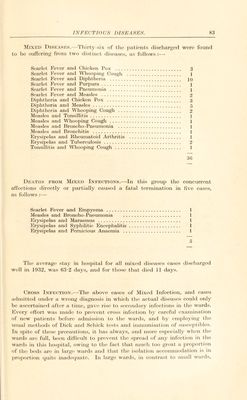
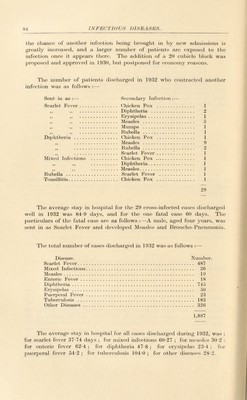
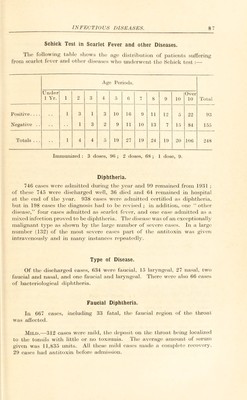
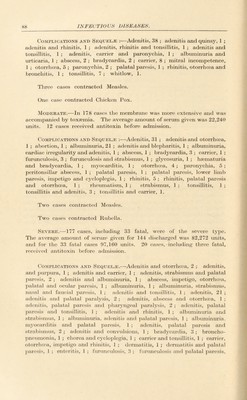
![Mixed Diseases.—Thirty-six of the patients discharged were found to be suffering from two distinct diseases, as follows:— Scarlet Fever and Chicken Pox . 3 Scarlet Fever and Whooping Cough . 1 Scarlet Fever and Diphtheria . ]0 Scarlet Fever and Purpura. 1 Scarlet Fever and Pneumonia . 1 Scarlet Fever and Measles . 2 Diphtheria and Chicken Pox . 3 Diphtheria and Measles. 5 Diphtheria and Whooping Cough . 2 Measles and Tonsillitis. 1 Measles and Whooping Cough . 1 Measles and Broncho-Pneumonia . 1 Measles and Bronchitis . 1 Erysipelas and Rheumatoid Arthritis . 1 Erysipelas and Tuberculosis. 2 Tonsillitis and Whooping Cough . 1 36 Deaths from Mixed Infections.—In this group the concurrent affections directly or partially caused a fatal termination in five cases, as follows :— Scarlet Fever and Empyema . 1 Measles and Broncho-Pneumonia . 1 Erysipelas and Marasmus . 1 Erysipelas and Syphilitic Encephalitis. 1 Erysipelas and Pernicious Anaemia . 1 5 The average stay in hospital for all mixed diseases cases discharged well in 1932, was 63-2 days, and for those that died 11 days. Cross Infection.—The above cases of Mixed Infection, and cases admitted under a wrong diagnosis in which the actual diseases could only be ascertained after a time, gave rise to secondary infections in the wards. Every effort was made to prevent cross infection by careful examination of new patients before admission to the wards, and by employing the usual methods of Dick and Schick tests and immunisation of susceptibles. In spite of these precautions, it has always, and more especially when the wards are full, been difficult to prevent the spread of any infection in tho wards in this hospital, owing to the fact that much too great a proportion of the beds are in large wards and that the isolation accommodation is in proportion quite inadequate. In largo wards, in contrast to small wards.](https://iiif.wellcomecollection.org/image/b30067388_0091.jp2/full/800%2C/0/default.jpg)