Elements of agricultural chemistry, in a course of lectures of the Board of Agriculture / By Sir Humphry Davy.
- Humphry Davy
- Date:
- 1846
Licence: Public Domain Mark
Credit: Elements of agricultural chemistry, in a course of lectures of the Board of Agriculture / By Sir Humphry Davy. Source: Wellcome Collection.
129/318 (page 113)
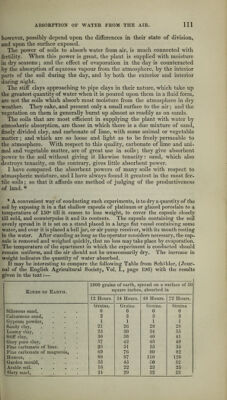
![which is commonly given to them of rich soils; for the vegetable nourish- ment is long preserved in them, unless taken up by the organs of plants. Siliceous sands, on the contrary, deserve the term hungry, which is com- monly applied to them; for the vegetable and animal matters they con- tain not being attracted by the earthy constituent parts of the soil, are more liable to be decomposed by the action of the atmosphere, or carried off from them by water. In most of the black and brown rich vegetable moulds, the earths seem to be in combination with a peculiar extractive matter, afforded during the decomposition of vegetables : this is slowly taken up, or attracted from the earths by water, and appears to constitute a prime cause of the fertility of the soil.* The standard of fertility of soils for different plants must vary with the climate; and must be particularly influenced by the quantity of rain. The power of soils to absorb moisture ought to be much greater in warm or dry counties, than in cold and moist ones ; and the quantity of clay, or vegetable or animal matter they contain greater. Soils also on declivities ought to be more absorbent than in plains or in the bottom of valleys. Their productiveness likewise is influenced by the nature of the subsoil or the stratum on which they rest. When soils are immediately situated upon a bed of rock or stone, they are much sooner rendered dry by evaporation, than where the subsoil is of clay or marl; and a prime cause of the great fertility of the land in the moist climate of Ireland, is the proximity of the rocky strata to the soil, f nearly so lasting, unless indeed, as sometimes happens, they contain also a good deal of finely divided aluminous matter. It is, however, quite consistent with the best experiments, that alkaline bases promote the decomposition of organic matter. In sandy and gravelly soils, in like manner, the rapid consumption of manures, and the necessity of applying to them frequent small doses, in place of one large dose, during the rotation, seem to be explained most simply by their looser texture. * Liebig has shewn that it is not soluble organic substances that constitute the proper food of plants. Organic matter decays by a peculiar process of slow oxidation, called by him Eremacausis. During this decay carbonic acid is evolved, and constitutes, along with the carbonic acid derived from the air, the principal part of the food of plants. Extractive matter is capable of this sort of decay, and consequently of supplying carbon to plants, but as extractive mat- ter it is not capable of assimilation ; it is a product of assimilation and cannot be regarded as forming directly the food of plants. [See notes to Lecture VI.] t Rocks differ much in this respect. The principal circumstances demanding attention in speculating on this topic, are their texture and inclination. Chalk, siliceous sandstone, conglomerate and all porous rocks lying immediately under the soil, imbibe the surface water, and to some extent, when the soil itself is of suitable texture, supply the want of drains. During protracted drought, a por- tion of the water thus imbibed by the subjacent rock is again restored to the soil, and supplies the plants growing in it. Some of the most fertile soils in the country are thus situated. When the subjacent rock is compact and impervious, as is the case with clays, shales, compact limestone, many slate-rocks, &c ,the water, in winter, and during wet weather, finding no outlet, stagnates, and produces sour and spongy bogs, in which rushes and marsh plants make their appearance. During continued drought again, these soils become baked and parched in a remarkable manner. The inclination of the strata is also important. Strata even of a close and compact texture, sometimes form a pretty good support for soil when they lie at a high angle, so that excess of water can percolate down between the layers. This high inclination is often met with in the rocks of the Grauwacke group, P](https://iiif.wellcomecollection.org/image/b2931236x_0129.jp2/full/800%2C/0/default.jpg)