Elements of agricultural chemistry, in a course of lectures of the Board of Agriculture / By Sir Humphry Davy.
- Humphry Davy
- Date:
- 1846
Licence: Public Domain Mark
Credit: Elements of agricultural chemistry, in a course of lectures of the Board of Agriculture / By Sir Humphry Davy. Source: Wellcome Collection.
262/318 (page 246)
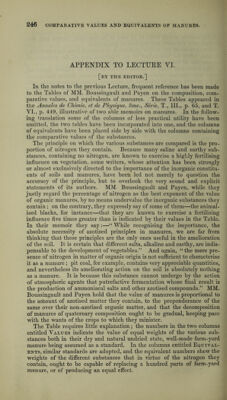
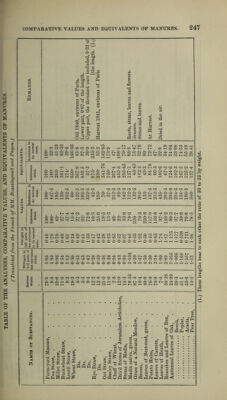
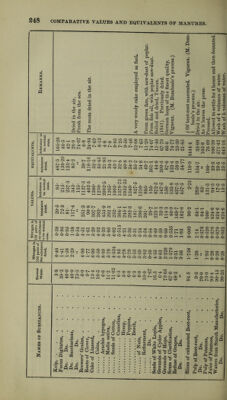
![APPENDIX TO LECTURE VI. [by the editor.] In the notes to the previous Lecture, frequent reference has been made to the Tables of MM. Boussingault and Payen on the composition, com- parative values, and equivalents of manures. These Tables appeared in the Annales de Chimie, et de Physique, 3me., Serie, T., III., p. 65, and T. VI., p. 449, illustrative of two able memoirs on manures. In the follow- ing translation some of the columns of less practical utility have been omitted, the two tables have been incorporated into one, and the columns of equivalents have been placed side by side with the columns containing the comparative values of the substances. The principle on which the various substances are compared is the pro- portion of nitrogen they contain. Because many saline and earthy sub- stances, containing no nitrogen, are known to exercise a highly fertilising influence on vegetation, some writers, whose attention has been strongly or almost exclusively directed to the importance of the inorganic constitu- ents of soils and manures, have been led not merely to question the accuracy of the principle, but to overlook the very sound and explicit statements of its authors. MM. Boussingault and Payen, while they justly regard the percentage of nitrogen as the best exponent of the value of organic manures, by no means undervalue the inorganic substances they contain ; on the contrary, they expressly say of some of them—the animal - ised blacks, for instance—that they are known to exercise a fertilising influence five times greater than is indicated by their values in the Table. In their memoir they say :—“ While recognising the importance, the absolute necessity of azotised principles in manures, we are far from thinking that these principles are the only ones useful in the amelioration of the soil. It is certain that different salts, alkaline and earthy, are indis- pensable to the development of vegetables.” And again, “ the mere pre- sence of nitrogen in matter of organic origin is not sufficient to characterise it as a manure ; pit coal, for example, contains very appreciable quantities, and nevertheless its ameliorating action on the soil is absolutely nothing as a manure. It is because this substance cannot undergo by the action of atmospheric agents that putrefactive fermentation whose final result is the production of ammoniacal salts and other azotised compounds.” MM. Boussingault and Payen hold that the value of manures is proportional to the aihount of azotised matter they contain, to the preponderance of the same over their non-azotised organic matter, and that the decomposition of manures of quaternary composition ought to be gradual, keeping pace with the wants of the crops to which they minister. The Table requires little explanation; the numbers in the two columns entitled Values indicate the value of equal weights of the various sub- stances both in their dry and natural undried state, well-made farm-yard manure being assumed as a standard. In the columns entitled Equival- ents, similar standards are adopted, and the equivalent numbers shew the weights of the different substances that in virtue of the nitrogen they contain, ought to be capable of replacing a hundred parts of farm-yard manure, or of producing an equal effect.](https://iiif.wellcomecollection.org/image/b2931236x_0262.jp2/full/800%2C/0/default.jpg)