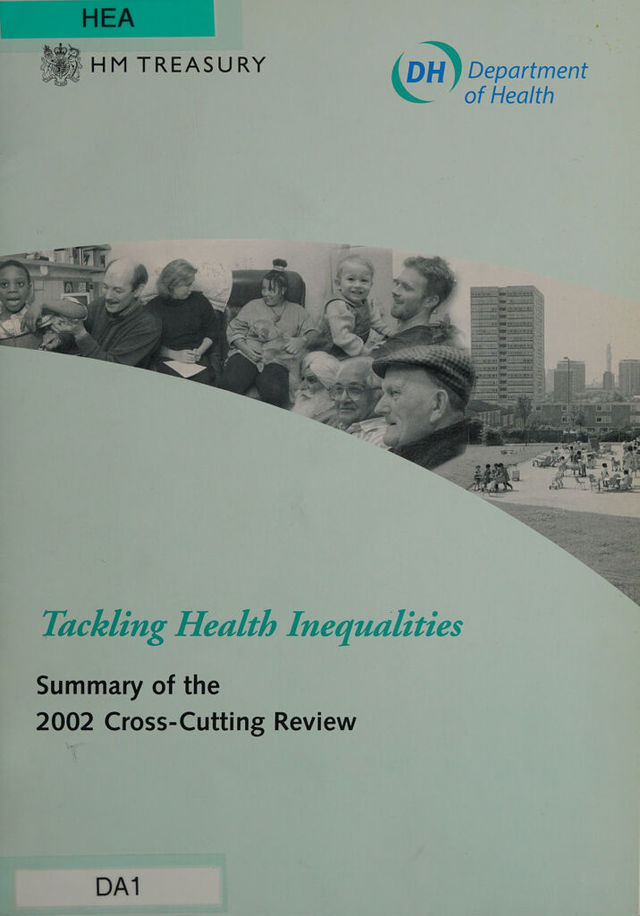
Tackling health inequalities : summary of the 2002 cross-cutting review / Department of Health.
- Great Britain. Department of Health
- Date:
- 2002
Licence: Open Government Licence
Credit: Tackling health inequalities : summary of the 2002 cross-cutting review / Department of Health. Source: Wellcome Collection.
19/28 page 11
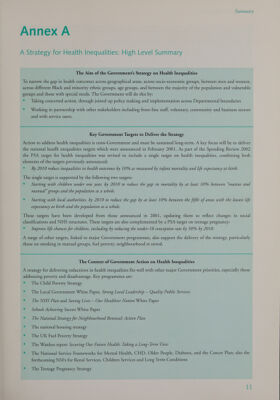
![Annex A A Strategy for Health Inequalities: High Level Summary The Aim of the Government's Strategy on Health Inequalities To narrow the gap in health outcomes across geographical areas, across socio-economic groups, between men and women, across different Black and minority ethnic groups, age groups, and between the majority of the population and vulnerable groups and those with special needs. The Government will do this by: ° Taking concerted action, through joined up policy making and implementation across Departmental boundaries ¢ Working in partnership with other stakeholders including front-line staff, voluntary, community and business sectors and with service users. Key Government Targets to Deliver the Strategy Action to address health inequalities is cross-Government and must be sustained long-term. A key focus will be to deliver the national heatlh inequalities targets which were announced in February 2001. As part of the Spending Review 2002 the PSA target for health inequalities was revised to include a single target on health inequalities, combining both elements of the targets previously announced: © By 2010 reduce inequalities in health outcomes by 10% as measured by infant mortality and life expectancy at birth. The single target is supported by the following two targets: ° Starting with children under one year, by 2010 to reduce the gap in mortality by at least 10% between “routine and manual” groups and the population as a whole. © — Starting with local authorities, by 2010 to reduce the gap by at least 10% between the fifth of areas with the lowest life expectancy at birth and the population as a whole. These targets have been developed from those announced in 2001, updating them to reflect changes in social classifications and NHS structures. These targets are also complemented by a PSA target on teenage pregnancy: ° Improve life chances for children, including by reducing the under-18 conception rate by 50% by 2010. A range of other targets, linked to major Government programmes, also support the delivery of the strategy, particularly those on smoking in manual groups, fuel poverty, neighbourhood re newal. The Context of Government Action on Health Inequalities A strategy for delivering reductions in health inequalities fits well with other major Government priorities, especially those addressing poverty and disadvantage. Key programmes are: ° The Child Poverty Strategy ° The Local Government White Paper, Strong Local Leadership — Quality Public Services ° The NHS Plan and Saving Lives— Our Healthier Nation White Paper ° — Schools Achieving Success White Paper ° The National Strategy for Neighbourhood Renewal: Action Plan ° The national housing strategy ° The UK Fuel Poverty Strategy ° The Wanless report Securing Our Future Health: Taking a Long-Term View © The National Service Frameworks for Mental Health, CHD, Older People, Diabetes, and the Cancer Plan; also the forthcoming NSFs for Renal Services, Children Services and Long Term Conditions ° The Teenage Pregnancy Strategy 1]](https://iiif.wellcomecollection.org/image/b32228818_0019.jp2/full/800%2C/0/default.jpg)