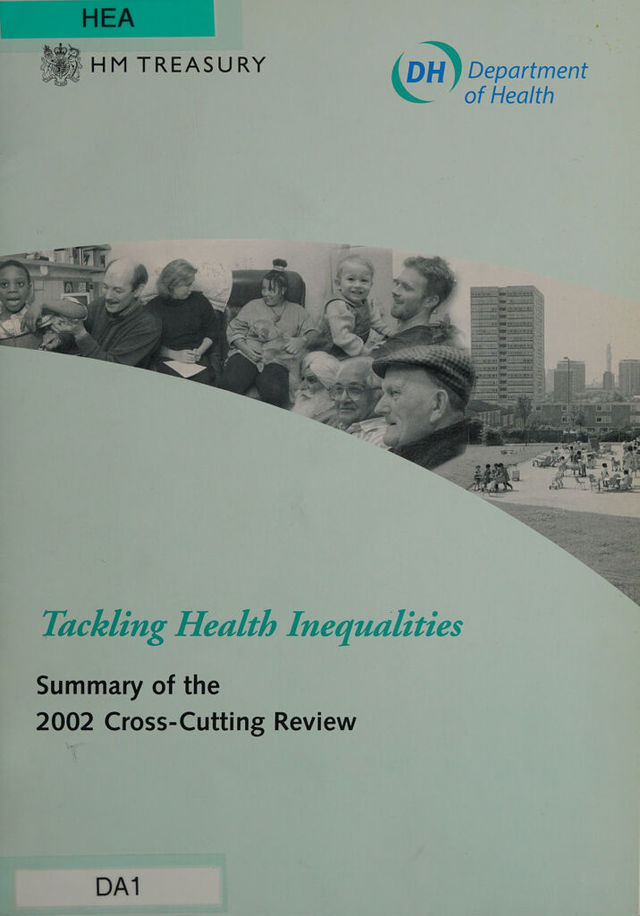
Tackling health inequalities : summary of the 2002 cross-cutting review / Department of Health.
- Great Britain. Department of Health
- Date:
- 2002
Licence: Open Government Licence
Credit: Tackling health inequalities : summary of the 2002 cross-cutting review / Department of Health. Source: Wellcome Collection.
20/28 page 12
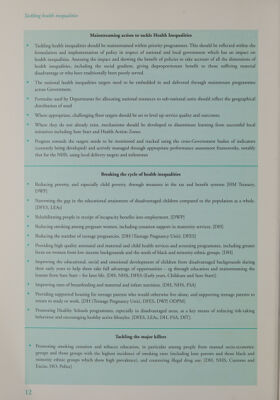
![12 Mainstreaming action to tackle Health Inequalities Tackling health inequalities should be mainstreamed within priority programmes. This should be reflected within the formulation and implementation of policy in respect of national and local government which has an impact on health inequalities. Assessing the impact and skewing the benefit of policies to take account of all the dimensions of health inequalities, including the social gradient, giving disproportionate benefit to those suffering material disadvantage or who have traditionally been poorly served. The national health inequalities targets need to be embedded in and delivered through mainstream programmes across Government. Formulae used by Departments for allocating national resources to sub-national units should reflect the geographical distribution of need Where appropriate, challenging floor targets should be set to level up service quality and outcomes. Where they do not already exist, mechanisms should be developed to disseminate learning from successful local initiatives including Sure Start and Health Action Zones. Progress towards the targets needs to be monitored and tracked using the cross-Government basket of indicators (currently being developed) and actively managed through appropriate performance assessment frameworks, notably that for the NHS, using local delivery targets and milestones Breaking the cycle of health inequalities Reducing poverty, and especially child poverty, through measures in the tax and benefit systems [HM Treasury, DWP] Narrowing the gap in the educational attainment of disadvantaged children compared to the population as a whole. [DFES, LEAs] Rehabilitating people in receipt of incapacity benefits into employment. [DWP] Reducing smoking among pregnant women, including cessation support in maternity services. [DH] Reducing the number of teenage pregnancies. [DH (Teenage Pregnancy Unit), DFES] Providing high quality antenatal and maternal and child health services and screening programmes, including greater focus on women from low income backgrounds and the needs of black and minority ethnic groups. [DH] Improving the educational, social and emotional development of children from disadvantaged backgrounds during their early years to help them take full advantage of opportunities — eg through education and mainstreaming the lessons from Sure Start — for later life. [DH, NHS, DFES (Early years, Childcare and Sure Start)] Improving rates of breastfeeding and maternal and infant nutrition. [DH, NHS, FSA] Providing supported housing for teenage parents who would otherwise live alone, and supporting teenage parents to return to study or work. [DH (Teenage Pregnancy Unit), DFES, DWP, ODPM] Promoting Healthy Schools programmes, especially in disadvantaged areas, as a key means of reducing risk-taking behaviour and encouraging healthy active lifestyles. [DFES, LEAs, DH, FSA, DfT]. Tackling the major killers Promoting smoking cessation and tobacco education, in particular among people from manual socio-economic groups and those groups with the highest incidence of smoking rates (including lone parents and those black and minority ethnic groups which show high prevalence), and countering illegal drug use. [DH, NHS, Customs and Excise, HO, Police]](https://iiif.wellcomecollection.org/image/b32228818_0020.jp2/full/800%2C/0/default.jpg)