Essentials of bacteriology : being a concise and systematic introduction to the study of micro-organisms for the use of students and practitioners / by M.V. Ball.
- Ball, M. V. (Michael Valentine), 1868-
- Date:
- 1904
Licence: In copyright
Credit: Essentials of bacteriology : being a concise and systematic introduction to the study of micro-organisms for the use of students and practitioners / by M.V. Ball. Source: Wellcome Collection.
34/254 (page 32)
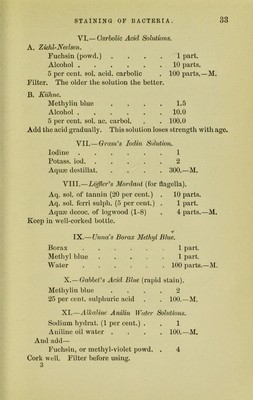
![lodin as used in Gram’s Method. Belonging to this group, but used more in the sense of a protective, is tincture of iodin. It picks out certain bacteria, which it coats; prevents them from being decolorized, but allows all else to be faded. Then by using one of the acid or tissue dyes, a contrast color or double staining is obtained. Many of the more important bacteria are not acted upon by the iodin, and it thus becomes a very useful means of diagnosis. Place about 10 grammes of the powdered dye in a bottle and add 40 grammes of alcohol. Shake well and allow to settle. This can be used as the stock bottle. II.— Weak Solutions. Made best by adding about 1 part of number I. or stock solu- tion to 10 of distilled water. This is the ordinary solution in use. Aniline oil ..... 5 parts. Distilled water .... 100 parts.—M. Shake well and filter. To be made fresh each time. IV.—Anilin Water Dyes. Sat. alcoh. sol. of the dye . . 11 parts. Aniline oil water .... 100 parts. Abs. alcohol 10 parts.—]\1 Can be kept 10 days. Formulas of different Staining Solutions. I.—Saturated Alcoholic Solution. III.—Anilin Oil Water. V.—Alkaline Methylin Blue. A. Loffler'^s. Sat. ale. sol. methylin blue . . 30 Sol. potass, hydrat. (1-10,000) . 100—M. B. Koclds. Sol. potass, hydrat. (10 per cent.) Sat. ale. sol. methyl, blue Distilled water • .A. • V/ . 200.0—M. 0.2 1.0](https://iiif.wellcomecollection.org/image/b28060660_0034.jp2/full/800%2C/0/default.jpg)