Text-book of skin diseases / by Dr. Isidor Neumann ... ; translated from the 2nd German edition, by special permission of the author, by Alfred Pullar.
- Neumann, Isidor von, 1832-1906.
- Date:
- 1871
Licence: Public Domain Mark
Credit: Text-book of skin diseases / by Dr. Isidor Neumann ... ; translated from the 2nd German edition, by special permission of the author, by Alfred Pullar. Source: Wellcome Collection.
Provider: This material has been provided by University of Bristol Library. The original may be consulted at University of Bristol Library.
69/360 page 45
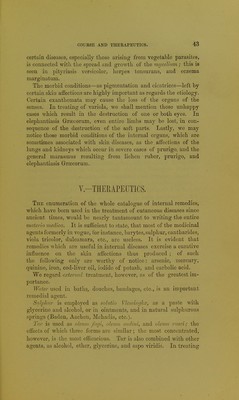
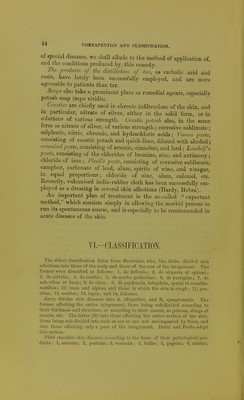
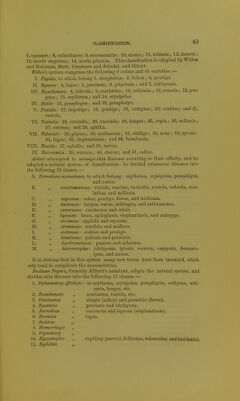
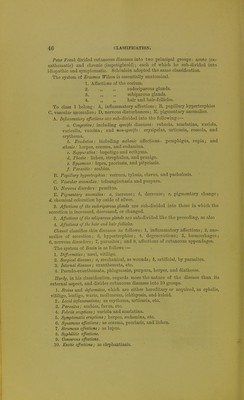
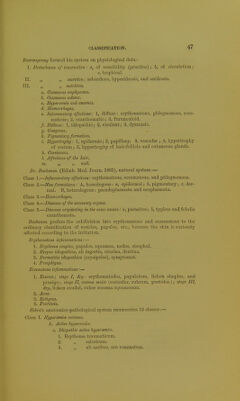
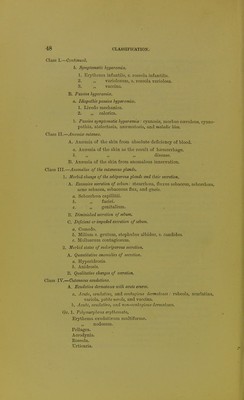
![7, squamce; 8, callositates; 9, excrescentiiB; lO.ulceraj 11, vulnera j 12, insecta; 13, morbi unguium; 14, movbi pilorum. This classification is adopted by Willan and Bateman, Biett, Cazenave and Scliedel, and Gibert. Willan's system comprises the following 9 orders and 41 varieties :— I. Papula, to which belong 1, strophulus; 2, lichen; 3, prurigo. 11. Squamce: 4, lepra; 5, psoriasis; 6, pityriasis; and 7, ichthyosis. III. Exanthemata: 8, rubeola; 9, scarlatina; 10, urticaria; 11,roseola; 12,pur- pm-a; 13, erythema; and 14, erysipelas. IV. Bullce: 15, pemphigus; and 16, pompholyx. V. Pmtulce: 17, impetigo; 18, porrigo; 19, ecthyma; 20, scabies; and 21, variola. VI. Vesieuloe: 22, varicella; 23, vaccinia; 24., herpes; 25, rupia; 26, miliaria; 27, eczema; and 28, aphtha. VII. Tuhermla: 29, phyma; 30, moUuscum; 31, vitiligo; 32, acne; 33, sycosis 34, lupus; 35, elephantiasis; and 36, frambcBsia. VIII. Mamloa: 37, ephelis; and 38, ncevus. IX. Excrcsctniia: 39, verruca; 40, clavus; and 41, callus. Alibert attempted to arrange skin diseases according to their affinity, and he adopted a natural system of classification: he divided cutaneous diseases into the following 12 classes:— A. Dermatoses eczemateuses, to which belong : erythema, erysipelas, pemphigus, and zoster. B. „ ezantJiemateuses: variola, vaccina, varicella, roseola, rubeola, scar- latina, and miliaria. C. ,, teigneuses: achor, porrigo, favus, and trichoma. D. „ rfarirawes.' herpes, varus, militagra, and esthiomenos. E. ,, cancereuses: carcinoma and celois. P. „ Zcprmei .• leuce, spiloplaxia, elephantiasis, and radesyge. G. ,, veroleuses: syphilis and mycosis. H. ,, sirumeuses: scrofula and malleus. I. „ scabieuses: scabies and prurigo. K. ,, hemaieuses: peliosis and petechise. L. „ dyschromateuses: pannus and achi'oma, M. „ heieromorphes: ichthyosis, tylosis, verruca, onygosis, dermato- lysis, and n£Evus. It is obvious that in this system many new terms have been invented, which only tend to complicate the nomenclature. Duchesne Duparc, formerly Alibert's assistant, adopts the natural system, and divides sldn diseases into the following 11 classes:— 1. Inflammatory affections: as erythema, erysipelas, pemphigus, ecthyma, urti- caria, herpes, etc. 2. Exanthematic „ scarlatina, variola, etc. 3. Orustaceous „ simple (achor) and parasitic (favus). 4. Squamous ,, psoriasis and ichthyosis. 5. Anomalous „ cancerous and leprous (elephantiasis). G. Strumous „ lupus. 7. Scabious „ 8. Bcemorrhagic „ 9. Pigmentary „ 10. jrypertro]}hic „ capillary (noevus), follicular, tuberculai', and incidental. 11. Syphilitic „](https://iiif.wellcomecollection.org/image/b21445904_0069.jp2/full/800%2C/0/default.jpg)
 No text description is available for this image
 No text description is available for this image
 No text description is available for this image