Copy 1, Volume 1
A bibliographical dictionary. Containing a chronological account ... of ... books, in all departments of literature ... with biographical anecdotes ... the whole of the fourth edition of Dr. Harwood's View of the classics, with innumerable additions and amendments. To which are added, an essay on bibiliography ... and an account of the best English translation of each Greek and Latin classic ... / [Anon].
- Adam Clarke
- Date:
- 1802-1804
Licence: Public Domain Mark
Credit: A bibliographical dictionary. Containing a chronological account ... of ... books, in all departments of literature ... with biographical anecdotes ... the whole of the fourth edition of Dr. Harwood's View of the classics, with innumerable additions and amendments. To which are added, an essay on bibiliography ... and an account of the best English translation of each Greek and Latin classic ... / [Anon]. Source: Wellcome Collection.
46/304 page 34
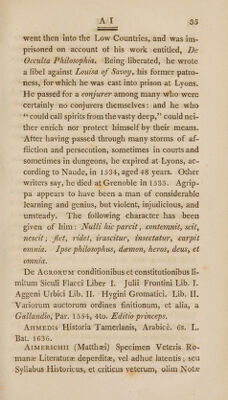
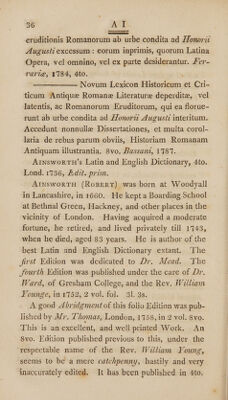
![years after Agrippa’s death. The best translation of the Occult Philosophy, is that published at the Hague, in 2 vol. 8vo, 1727. Chez 2. Chr. Alberts. This isa very beautiful edition, elegantly printed, with the principal Tables, Figures, Characters, &c. finely engraved on copper: prefixed to which is M. G. Naudé’s Apology for the Author. Lately in Baynes’s Catalogue for 10s. 6d. His Vanity of the Sciences, and Honour of the Female Sex, were translated by Guedeville, and published at Paris in 1726, 3 vol. 12mo. The English 4to. edition of the Occult Philosophy was printed in 1651, and an edition of the fourth Book was reprinted in 8vo. 1783, A complete copy sells for 3]. 3s, Acrippa (Henry Cornelius) was born at Cologne, in 1486, of a very vespectable family. He was: at first secretary to the Emperor: Maximilian I. and afterwards served in that Emperor’s army. Having attacked the then prevailing opinion ¢hat St. Anne had three husbands, he was so violently persecuted by the supporters of that grave te- net, that he was obliged to fly from place to place; and was a vagabond, and almost a beggar, in Germany, Switzerland, and England. Having stopped some time at Lyons, he was made physi- cian to Louisa of Savoy, mother: of Francis I. This princess was greatly addicted to astrology; “and as Agrippa could discover nothing in the stars, which promised either her or her son any especial good fortune, he got into disgrace. He](https://iiif.wellcomecollection.org/image/b33029404_0001_0046.jp2/full/800%2C/0/default.jpg)
 No text description is available for this image
 No text description is available for this image
 No text description is available for this image