Lectures on orthopedic surgery : and diseases of the joints : delivered at Bellevue Hospital Medical College, during the session of 1874-1875 / by Lewis A. Sayre.
- Lewis Sayre
- Date:
- 1885
Licence: Public Domain Mark
Credit: Lectures on orthopedic surgery : and diseases of the joints : delivered at Bellevue Hospital Medical College, during the session of 1874-1875 / by Lewis A. Sayre. Source: Wellcome Collection.
Provider: This material has been provided by the Harvey Cushing/John Hay Whitney Medical Library at Yale University, through the Medical Heritage Library. The original may be consulted at the Harvey Cushing/John Hay Whitney Medical Library at Yale University.
567/612 (page 539)
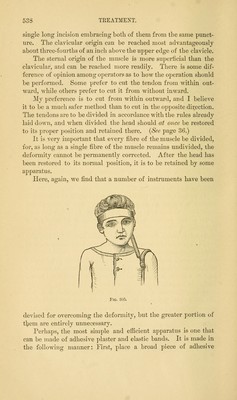
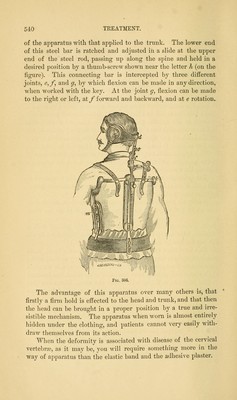
![plaster across the forehead, to keep your bandage from slipping. To each extremity of this piece of piaster a strip of muslin is at- tached, which goes around the head and is fastened. To this bandage, passing around the head, an elastic band is attached upon the side opposite the deformity, carried through the axilla, and returned to the place of beginning. ]Sow, this elastic band can be made as short as necessary to retain the head in its normal position, and it keeps a constant traction in the proper direction to turn the head around to its normal position. {See Fig. 305.) In this case it will be observed that the head is not yet entirely restored to the natural position; but the constant traction will in time accomplish this object. The change in the position of the child's head, by the application of this elastic force, even during the few minutes it has been used, must be apparent to you all. This apparatus is very efficient for overcoming the deformity in the paralytic variety, or in any case when it can be overcome without the operation of tenotomy. The principle which should govern you in the treatment of this class of cases is, to supply the deficiency in muscular power by substituting elastic force. ^Nearly all the complicated machinery, therefore, which may be seen in the shops for correcting wry-neck, is of no use what- ever. If, however, it is desirable to furnish your patient with a beautiful instrument, you can probably do no better than to use the one devised by Mr. Reynders. {See Fig. 306.) This apparatus consists of a well-padded pelvic band, a, to which an upright steel bar is attached at I, passing upward along the spine to the upper dorsal region. A cross-bar, c, is attached to its upper end, passing from one axilla to the other, and fastened to two crutches, h, fitting well under the arm. These are con- nected to the pelvic band by two lateral bars, m, which by means of a slot and screw can be raised and lowered somewhat, at will. The part of the apparatus so far described is applied firmly to the trunk by means of straps passing over the shoulder and fastened to the axillary cross-bar at c c. A firm hold of the head is secured by a pad, sheet-steel inside, reaching almost from eye to eye back- ward around the skull, with apertures for the ears, and fastened to the head by straps over the forehead and under the chin. To its back part a steel bar is riveted, d, which connects the upper part](https://iiif.wellcomecollection.org/image/b21005114_0567.jp2/full/800%2C/0/default.jpg)