The Latin grammar of pharmacy for the use of medical and pharmaceutical students with an essay on the reading of Latin prescriptions.
- Ince, Joseph
- Date:
- 1882
Licence: Public Domain Mark
Credit: The Latin grammar of pharmacy for the use of medical and pharmaceutical students with an essay on the reading of Latin prescriptions. Source: Wellcome Collection.
Provider: This material has been provided by UCL Library Services. The original may be consulted at UCL (University College London)
10/196 (page 2)
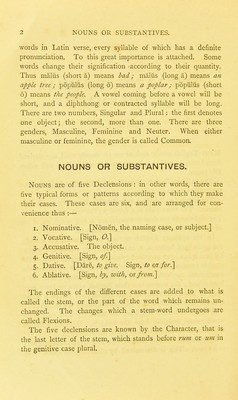
![words in Latin verse, every syllable of which has a definite pronunciation. To this great importance is attached. Some words change their signification -according to their quantity. Thus maliis (short a) means bad; malus (long a) means aji apple tree ; populiis (long 6) means a poplar; populiis (short 6) means the people. A vowel coming before a vowel will be short, and a diphthong or contracted syllable will be long. There are two numbers, Singular and Plural: the first denotes one object; the second, more than one. There are three genders, Masculine, Feminine and Neuter. When either masculine or feminine, the gender is called Common, NOUNS OR SUBSTANTIVES. Nouns are of five Declensions : in other words, there are five typical forms or patterns according to which they make their cases. These cases are six, and are arranged for con- venience thus :— 1. Nominative. [Nomen, the naming case, or subject.] 2. Vocative. [Sign, (9.] 3. Accusative. The object. 4. Genitive. [Sign, ofi\ 5. Dative. [Dare, to give. Sign, to or for^ 6. Ablative. [Sign, by, with, ox from.] The endings of the different cases are added to what is called the stem, or the part of the word which remains un- changed. The changes which a stem-word undergoes are called Flexions. The five declensions are known by the Character, that is the last letter of the stem, which stands before rum or urn in the genitive case plural.](https://iiif.wellcomecollection.org/image/b21687274_0010.jp2/full/800%2C/0/default.jpg)