Obstetric operations, including the treatment of haemorrhage / by Robert Barnes ... with additions by Benjamin F. Dawson.
- Robert Barnes
Licence: Public Domain Mark
Credit: Obstetric operations, including the treatment of haemorrhage / by Robert Barnes ... with additions by Benjamin F. Dawson. Source: Wellcome Collection.
Provider: This material has been provided by the Francis A. Countway Library of Medicine, through the Medical Heritage Library. The original may be consulted at the Francis A. Countway Library of Medicine, Harvard Medical School.
77/580 page 49
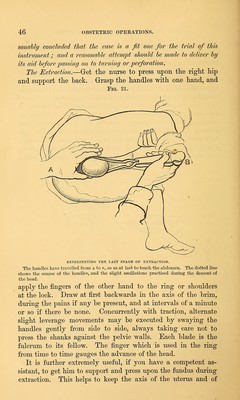
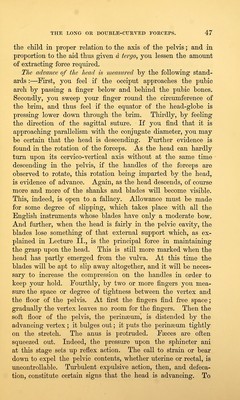
![it is well to understand. You apply tlie palms of both hands one on either side and behind to the perinseum distended by the head; and bearing upon this structure so as to press it a little backwards, whilst the head is pushed forwards towards the pubic arch, the head is, as it were, shelled out by being made to complete its movement of extension. Steady pressure by the hands of an assistant or by a binder upon the fundus uteri will much assist the extension of the head. In this manner I once extricated myself and my patient from an awkward predicament. I had been summoned into the country without knowing the nature of the case, and had no instru- ments. I found a lady who had been many hours in labour, the head on the perineeum, and no pains. The lever or the forceps would have delivered her in a minute. Neither was to be had. But the manoeu\Te I have described perfectly succeeded, and put an end to a state of extreme anxiety, and even danger. Another manoeu\Te is occasionally serviceable. This is to pass a finger into the rectum, so as to get a point of pressure upon the forehead. In this way it is sometimes possible to bring the face downwards, to start the extension movement, and thus to extricate the head delayed at the outlet. And if at the same time firm downward pressure be made u]3on the breech through the fundus, as described in the first lecture, the force propagated through the spine will aid materially in giving the extension movement. This combination of the prin- ciples of pushing, of leverage, and of shelling-out, may in certain cases enable you to deliver without resorting to the forceps or lever. When the blades are adjusted, they will not lie exactly in the transverse diameter of the pelvis. The head, lying between the transverse and right oblique diameter, will tend to throw off the blades towards the opposite or left oblique diameter. The head then will be seized obliquely, one blade grasping the right brow, the other the left occiput. This is clearly demon- strated by the impressions of the fenestrse left on the scalp. The blades naturally find their way into this position if they are introduced gently. One tendency of this oblique seizure is to assist the head in its axial rotation, face sacrumwards, as it descends into the pelvis. It is also an answer to an objeC' E](https://iiif.wellcomecollection.org/image/b21039926_0077.jp2/full/800%2C/0/default.jpg)

 No text description is available for this image
 No text description is available for this image
 No text description is available for this image