A monograph of the Anopheles mosquitoes of India / by S.P. James and W. Glen Liston.
- Sydney Price James
- Date:
- 1904
Licence: In copyright
Credit: A monograph of the Anopheles mosquitoes of India / by S.P. James and W. Glen Liston. Source: Wellcome Collection.
29/238 (page 13)
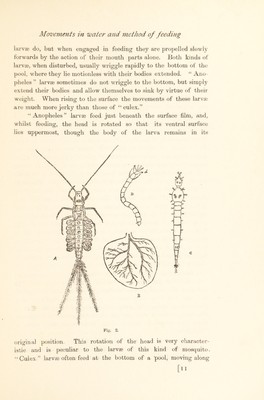
![The Pupa and the Imago only by violent exertions with their tails. As soon as these move- ments of the tail cease, the buoyant pupa floats up to the surface again. Like the larvae, they breathe air through protruding spiracles ; but these air tubes, instead of being at the tail end, as in the larva, are placed on the dorsum of the thorax, as two trumpet-shaped structures, projecting like horns. (PI. II, flgs. 3, 4.) The length and shape of these spiracles enable anopheles ” pupae to be distinguished from those of culex.” Anopheles” pupae have short, stumpy, funnel-shaped spiracles (PL II, fig. 4), while those of culex ” are longer, more slender, and trumpet-shaped (PI. II, fig- 3). The Adult Mosquito or Imago The adult mosquito is divided into three regions: (1) the heard, ( 2) the thorax, (3) the abdomen. To the head are attached sensory and suctorial appendages ; while to the thorax are attached the legs and wings. {See Descriptive Diagram of a female anopheles. Coloured plate No. I.) The head is rounded and attached to the thorax by a narrow neck The portion of the head near the neck is called the nape. Above and in front of the nape is the occiput. In front of the occiput, and occupying the greater part of the antero-lateral portion of the head, are the two compound eyes. Immediatel}^ anterior to the eyes, on either side, arise the antennae, which are long, jointed structures covered with hairs. In the male the antennae are very prominent hairy organs (PI. Ill, figs. 1,3); in the female they are less conspicuous and almost devoid of hairs. (PI. Ill, figs. 2, 4). In front of the antennae will be noted a firm median chitinous prolongation, the clypeus.” Beneath the clypeus arise the mouth parts, which consist of seven pieces collectively termed the proboscis. The mouth parts are :— (1 ) the upper li]D, made up of labrum and epipharynx ; (2 ) & ( 31 two mandibles ; (4 ) & (5) two maxillae ; (6) the hypopharynx or tongue ; (7) the lower lip or labium. The labium is a grooved structure, within which the other six mouth parts are enclosed. [13](https://iiif.wellcomecollection.org/image/b28991187_0033.jp2/full/800%2C/0/default.jpg)