Trees : a handbook of forest-botany for the woodlands and the laboratory.
- Harry Marshall Ward
- Date:
- 1904-09
Licence: Public Domain Mark
Credit: Trees : a handbook of forest-botany for the woodlands and the laboratory. Source: Wellcome Collection.
Provider: This material has been provided by the Gerstein Science Information Centre at the University of Toronto, through the Medical Heritage Library. The original may be consulted at the Gerstein Science Information Centre, University of Toronto.
90/184 page 78
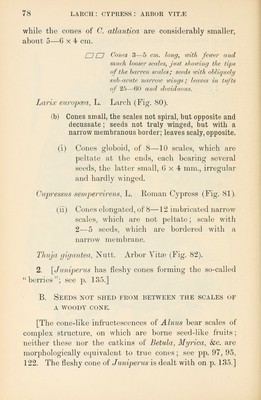
![while the cones of C. atlantica are considerably smaller, about 5—6 x 4 cm. /Z7ZZ7 Cones 3—5 cm. long, ivith fewer and much looser scales, just showing the tips of the barren scales; seeds with obliquely sub-acute narrow wings; leaves in tufts of 25—60 and deciduous. Larix europcea, L. Larch (Fig. 80). (b) Cones small, the scales not spiral, but opposite and decussate; seeds not truly winged, but with a narrow membranous border; leaves scaly, opposite. (i) Cones globoid, of 8—10 scales, which are peltate at the ends, each bearing several seeds, the latter small, 6x4 mm., irregular and hardly winged. Gwpressus sempervirens, L. Roman Cypress (Fig. 81). (ii) Cones elongated, of 8—12 imbricated narrow scales, which are not peltate; scale with 2—5 seeds, which are bordered with a narrow membrane. Thuja gigantea, Nutt. Arbor Vitse (Fig. 82). 2. [Juniperus has fleshy cones forming the so-called berries; see p. 135.] B. Seeds not shed from between the scales of A WOODY CONE. [The cone-like infructescences of Alnus bear scales of complex structure, on which are borne seed-like fruits; neither these nor the catkins of Betula, Myrica, &c. are morphologically equivalent to true cones; see pp. 97, 95, 122. The fleshy cone of Juniperus is dealt with on p. 135.]](https://iiif.wellcomecollection.org/image/b20996068_0090.jp2/full/800%2C/0/default.jpg)