Trees : a handbook of forest-botany for the woodlands and the laboratory.
- Harry Marshall Ward
- Date:
- 1904-09
Licence: Public Domain Mark
Credit: Trees : a handbook of forest-botany for the woodlands and the laboratory. Source: Wellcome Collection.
Provider: This material has been provided by the Gerstein Science Information Centre at the University of Toronto, through the Medical Heritage Library. The original may be consulted at the Gerstein Science Information Centre, University of Toronto.
93/184 page 81
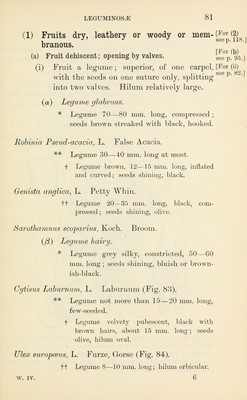
![(1) Fruits dry, leathery or woody or mem- tFor (?) v ' , J' ^ ■* seep. 118.1 branous. (a) Fruit dehiscent; opening by valves. seep. 95.] (i) Fruit a legume; superior, of one carpel, [For (ii) with the seeds on one suture only, splitting into two valves. Hilum relatively large. (a) Legume glabrous. * Legume 70—80 mm. long, compressed; seeds brown streaked with black, hooked. Robinia Pseud-acacia, L. False Acacia. ** Legume 30—40 mm. long at most. t Legume brown, 12—15 mm. long, inflated and curved; seeds shining, black. Genista anglica, L. Petty Whin. tt Legume 20—35 mm. long, black, com- pressed; seeds shining, olive. ISarothamnus scoparius, Koch. Broom. (/3) Legume hairy. * Legume grey silky, constricted, 50—60 mm. long; seeds shining, bluish or brown- ish-black. Cytisus Laburnum, L. Laburnum (Fig. 83). ** Legume not more than 15—20 mm. long, few-seeded. t Legume velvety pubescent, black with brown hairs, about 15 mm. long; seeds olive, hilum oval. Ulex europcBus, L. Furze, Gorse (Fig. 84). tt Legume 8—10 mm. long; hilum orbicular, w. iv. 6](https://iiif.wellcomecollection.org/image/b20996068_0093.jp2/full/800%2C/0/default.jpg)