Paralyses, cerebral, bulbar and spinal : a manual of diagnosis for students and practitioners / by H. Charlton Bastian.
- Henry Charlton Bastian
- Date:
- 1886
Licence: Public Domain Mark
Credit: Paralyses, cerebral, bulbar and spinal : a manual of diagnosis for students and practitioners / by H. Charlton Bastian. Source: Wellcome Collection.
Provider: This material has been provided by Royal College of Physicians, London. The original may be consulted at Royal College of Physicians, London.
40/720 page 20
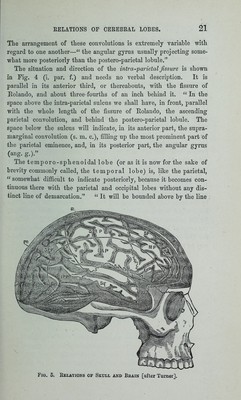
![frontal convolutions will occupy a space about three-quarters of an inch broad parallel with, and in front of, the line for the fissure of Rolando (Fig. 4). Fig. 4. Relative Position of Fissures and Convolutions of the outer surface of the Right Hemisphere [after Reid]. + Most prominent part of parietal eminence, a, Convex line bounding parietal lobe below, b, Convex line bounding temporo-sphenoidal lobe behind, lfr. c., First frontal convolution, lfr. f., First frohtal fissure. f.R., Fissure of Rolando. Sy. f., Sylvian fissure. Sy. h. f., Horizontal limb of Sylvian fissure. Sy. a. f., Ascending limb of Sylvian fissare. p. o. f., Parieto-occipital fissure, i. par. f., Intra-parietal fissure, ang. g., Angular gyrus, s. m. c., Supra marginal convolu- tion. 11. s. c., First temporo-sphenoidal convolution. 11. s. f., First temporo- sphenoidal fissure. 1 o. c., First occipital convolution, p. p. 1., Postero-parietal lobule. The boundaries of the frontal lobe are obvious ; it extends backwards as far as the fissure of Rolando, and downwards as low as the fissure of Sylvius. The parietal lobe is of a Y-like shape, being bounded in front by the fissure of Rolando, below by the posterior half of the Sylvian fissure and the parieto-occipital fissure, whilst in the intermediate region (represented in Fig. 4 by the curved line a) its boundary is subject to much variation in different brains. This region is occupied by the junction of the postero-parietal lobule with the first annectent convolution of the occipital lobe, and by the junc- tion of the angular gyrus with the second annectent convolution^](https://iiif.wellcomecollection.org/image/b24975199_0040.jp2/full/800%2C/0/default.jpg)



 No text description is available for this image
 No text description is available for this image
 No text description is available for this image