Volume 1
The Cyclopaedia of practical medicine : comprising treatises on the nature and treatment of diseases, materia medica and therapeutics, medical jurisprudence, etc., etc. / edited by John Forbes ... Alexander Tweedie ... John Conolly.
- Date:
- 1833-1835
Licence: Public Domain Mark
Credit: The Cyclopaedia of practical medicine : comprising treatises on the nature and treatment of diseases, materia medica and therapeutics, medical jurisprudence, etc., etc. / edited by John Forbes ... Alexander Tweedie ... John Conolly. Source: Wellcome Collection.
Provider: This material has been provided by King’s College London. The original may be consulted at King’s College London.
18/858 page 2
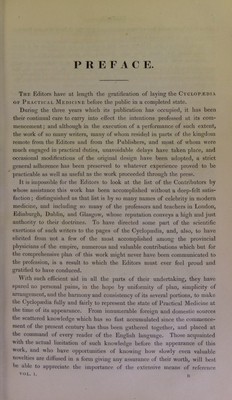
![■2 I'llEI’ACE. which tlie Cyclopicdiu has at once introduced into the library of many Liiglish ]>ractitioners at home and abroad. The ambition of the Editors was not limited to the formation of a mere manual, fitted for those who only demand the smallest supply of exact intelligence with which practice can be carried on, or professional station maintained without a palpable exposure of ignorance. Iheir object was no less than to prepare a compendium of the best parts of ancient and modern medicine, theoretical and practical; not passing over w'ith disregard the vast literature of the ancient writers, but rather rescuing it from the voluminous oblivion in w'hich much of it was lost j and also collecting with care the more accurate, condensed, and ajiplicable knowledge of modern authors and of modern times into a liberal and consistent system, from works little known to the generality of English readers, and familiarly known to very few. 'flius, whilst the great claims of the older cultivators of medicine have never been forgotten, the labours of the moderns, and more particularly of the French, German, and Italian pathologists, by which, conjointly with those of British jnactitioners, the whole face of practical medicine may be said to have been changed, have attracted the most diligent and thoughtful attention. The learned reader does not recjuire to be assured that the task of reference for specific information to many older works, once of high and deserved authority, and still esteemed, is often both tedious and little profitable, whilst their ample volumes yet contain much valuable matter, not unworthy of preservation, and which it is no fruitless employment to endeavour to place along with the better arranged facts of later writers, in one view', before the practitioner and the student. Throughout the prosecution of this large design, it has never been forgotten that the Cyclop-mdia would be referred to by various readers for various objects; by the young practitioner as the guide and counsellor of practice, especially when beset with practical dilHculties; by the older practitioner for complete and concise information, and for medical learning not scanty and illiberal, but without scholastic pedantry; and by the student for applicable knowledge, suited to the actual time, collateral w ith and auxiliary to his prescribed studies, and satisfactorily directing the efforts of his inquiring mind. At the commencement of such an undertaking, it was diflicult not to call in question the ])robability of its meeting w'ith adecpiate encouragement. No such work existed in this country; and although works on a plan somewhat similar had been very favourably accepted on the Continent, still it might have been urged that the English were eminently, almost exclusively, a practi- cal people,—that their medicine, in the opinion of foreign critics, who appeared to be dispassionate and impartial, was essentially empirical,—and that until a very recent period undeniable prejudices existed in the minds of many English practitioners of known jjractical skill, against all attempts to append theory to the deductions of mere experience. Of the English works know’n to have](https://iiif.wellcomecollection.org/image/b21306515_0001_0018.jp2/full/800%2C/0/default.jpg)


 No text description is available for this image
 No text description is available for this image
 No text description is available for this image