Volume 1
The Cyclopaedia of practical medicine : comprising treatises on the nature and treatment of diseases, materia medica and therapeutics, medical jurisprudence, etc., etc. / edited by John Forbes ... Alexander Tweedie ... John Conolly.
- Date:
- 1833-1835
Licence: Public Domain Mark
Credit: The Cyclopaedia of practical medicine : comprising treatises on the nature and treatment of diseases, materia medica and therapeutics, medical jurisprudence, etc., etc. / edited by John Forbes ... Alexander Tweedie ... John Conolly. Source: Wellcome Collection.
Provider: This material has been provided by King’s College London. The original may be consulted at King’s College London.
846/858 page 710
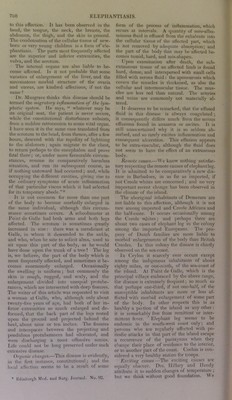
![Elephantiasis OR.a:coiiUM. (Tubercular <Icpliautiusis.) Miicli confusion existed, till very lately, in consequence of this term hav- ing been applied to two totally dissimilar aflec- tions. The Arabians, we have seen, appropriated the term answering in their languaue to ele- ])hanti:usis to an enormously swollen state of the leg; whilst the Greeks designated by it the peculiar tnl)ercular disease which we are about to describe; the appellation being pro- bably suggested to them either by the severity and protracteil duration of the disorders, or by the coimseness and in.sensibility of the skin presenting some analogy to the rough hide of the elephant. The tubercular elephantiasis occiLsionally, also, received the name laintutsis from certain of the old (Jreek writers, in con- seijnence of a fiuiciful likeness which they discovered in the stern and wrinkled visage, with its prominent brow and round eye, to tliat of a lion. It is the juzaiii of the older Ara- bians, and is still designated by a very similar name not only in Arabia, but also in Egypt, Persia, and India. The translatoi's of the Arabian writers en- tailed additional ob.scurity on a subject already sutticiently involved, by rendering the Arabic word which indicates this tubercular diseiuse, by the Latin term lepra, which is projierly api^licable only to the well-known sc*aly affec- tion ; and the error hence arising has received, even in our own day, still further countenance and circulation, by it{> adoption in the splendid work of Alibert, and in tlie invaluable .system of Frank. Elephantiasis of the Greeks is characterized by the existence of numerous flattened glossy tubercles, of a reddish or dark colour, varying in size from that of a split-pea to that of a large nut, and occupying usually the face, ears, or limbs. The skin is irregularly thickened and wrinkled, with a diminution of its sen- sibility, and a swollen appearance of the af- fected part. The hairs fall off from almost all parts of the body exce|)t the scalp. \\'hen a European is the subject of this frightful dis- ease, the whole skin of the parts attacked becomes of a dirty brownish or bronzed co- lour, approaching to that of a Mulatto. As the disease advances, some of the tubercles ter- minate in resolution, whilst others crack and ulcerate; these ulcenitions, however, rarely become either deep or extensive, but furnish a glutinous matter which concretes into solid crusts, beneath which cicatrization usually takes place. The progress of each tubercle is quite independent of those in its neighbour- hood, and is unaccompanied with pain, save in the ulcerated state. One of the most accurate descriptions of the disease is that by Dr. Kinnis, who saw several cases of it in the Isle of France. The face was generally swollen, with large tuber- cles on the forehead, separated from each other by deep furrows; and smaller and more confluent ones on the cheeks, which occasion- ally hung down, so as to depress the angles of the mouth ; the ala* of the nose were di- lated, distorted, iuid covered with tubercles ; the ears thickened, enlarged, and studded over with similar substances, and the lips iRine- trated by hard whitish bodies, which looked somewhat like recent cicatrices. In Miilattoes the tubercles were of a light livid or copper colour, aud in blacks a shade deeper than the surrounding skin. The cuticular lines and folds were every where more distinct and larger than natural. “ Hie deeply wrinkled forehead, the bare swollen eyebrows, the heavy pendulous cheeks, the irregular expanded nose, the dejiressed mouth, and the thickened elon- gated earlobes, combined to render the whole visage singularly harsh and uncouth.” Similai* reddish shining tubercles, but of a smaller size, usually exist within the mouth, occupying the palate, uvula, and fauces, and frequently undergo a superficial ulceration : but this is attended with so little pain that the individual is often quite unaware of their ex- istence, even when they are in the ulcerated state. The mucous membrane of the nose is occasionally implicated, being liable to an abun- dant discharge of matter, to hemorrhage, and even to ulceration. The sense of smell is often totally lost, the breath becomes very fetid, and the nose may eventually be flat- tened from the destruction of the sejitum. The frontal sinuses are sometimes attacked, as is indicated by a dull pain in this region ; and the voice, in almost every instance, be- comes na.sal and hoarse, and affords evidence of the larynx being aHected. The conjunctiva of the eye occasionally suffers, and the vision l)ecomes in some degree obscured. The progress of the tubercles on the ex- tremities is altogether similar to that of those on the face; they develope themselves slowly, become inflamed, and subsequently pass into resolution or ulceration. They are most nu- merous on the external surfaces of the limbs, whilst the inside of the thighs and arms, and the flexures of the joints usually escape. The skin of the fore-arms and of tlie legs is often not only tuberculated, but also scaly and scabbed, and particularly so about the knee and elbow joints. In the case of a young man which we .saw some years ago in the Ildpital St. Louis at Paris, thin filmy scales were very evident be- tween the tubercles. These existed chiefly on the face and arms, which were of a dirty brown colour, whilst the seat of old ulcerations was marked by still browner discolourations. There was considerable insensiblity in some of the diseased patches about the wrist. 1 he case was of old standing, and accompanied by great emaciation and debility. Ulcerations of the ala: nasi and throat had taken place, and the voice was much affected. But, although a slight degree of scaliness occasionally occurs, as in the above case, it is not a characteristic feature of the disease; for it is neither an original nor a universal .sym- ptom. The feet and hands are usually much sw ollen,](https://iiif.wellcomecollection.org/image/b21306515_0001_0846.jp2/full/800%2C/0/default.jpg)