The yellow fever epidemic of 1878, in Memphis, Tenn. : Embracing a complete list of the dead, the names of the doctors and nurses employed, names of all who contributed money or means, and the names and history of the Howards, together with other data, and lists of the dead elsewhere / By J.M. Keating.
- Keating, John McLeod, 1830-1906
- Date:
- 1879
Licence: Public Domain Mark
Credit: The yellow fever epidemic of 1878, in Memphis, Tenn. : Embracing a complete list of the dead, the names of the doctors and nurses employed, names of all who contributed money or means, and the names and history of the Howards, together with other data, and lists of the dead elsewhere / By J.M. Keating. Source: Wellcome Collection.
Provider: This material has been provided by London School of Hygiene & Tropical Medicine Library & Archives Service. The original may be consulted at London School of Hygiene & Tropical Medicine Library & Archives Service.
421/462 (page 417)
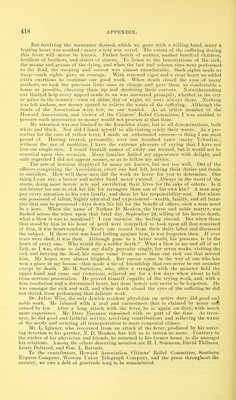
![FAMILIES OF MEMBERS SICK. Miss Sallie D. Stephenson. ' Mrs. H. .J. McGrann, son and niece Mrs. B. N. Catting. Mrs. J. P. Wlieles an.l child. Mrs. Crowell and son. Five nieml)ers of fauiilvof .Josejjh Crabb. Mrs. W. \V. Stephenson and two chihh-en. Mrs. W. II. Blahjck anil child. Mrs. Frank Van Horn and three children. ]Mrs. T. P. Holland and two daughters. Miss Schiller. Three Misses Keneau and brotlier. FAMILIES OF MEMBERS DEAD. W. S. Brooks' mother, wife, and .sou. II. M. Crowell's daugliter. H. .J. McGrann's daughter, (jieorge Bird'.s child. Major W. G. Stephenson's two daughters. Ed. Schiller's son. Josc2)h Crabb'.s sou. KEPORT OF THE HEBREW HOSPITAL ASSOCIATION. 2h (he Officers and Members of the Hchreir Hospital Association : Although not a member of your organization, by force of circnmstances I am nec- essarily compelled to submit to you the result of my labors during the late epidemic. Hardly had we experienced the effects of the peace following the scourge of 187.'^, when we were compelled to listen to the trumpets from near and far calling to arms all able-bodied men and women to tight an enemy far more dangerou.s and destructive than any experienced in the annals of history—a battle where tlie implements used consisted not of musketry, but of knowledge. Althougli the highest attainment of such was reached, yet we felt the effects of the terrible scourge of 1878. Like an adder it came unseen, darting its poi.sonou.s fangs into nearly every hon.se in the city and .surrounding country, without respect to quality. The rich and poor, educated and uneducated, old and young, were all placed upon a level, each sharing tlie same danger. Tlie timid who .sought their hiding-place, and the brave man who had faced danger in time of war and feared not death, were also classed among the victims. The suffering among our co-religionists was as great as any. The bulk of them were poor and destitute, and unable to reach places of .safety. For the time being they tliought themselves secure; but hardly had the fever reached its zenith before the sur- rounding country felt its deadly ettects. To our utter dismay we found every avenne leading to the city densel}^ packed with Jewish families, and with few exceptions did any escape the force of the fever. To speak of the sights and sufferings witnessed would fill volumes; yet to sliow our co-religionists and others who donated to our cause, an item or so is not out of place. Picture yourself at home, living in luxury and good health, enjoying every comfort imaginable and receiving the caresses of your children; then, on the contrary, find youi-self away froni the busy walks of life, living in an old log cabin or C(n'n-criii, far out in the woods, almost away from civilization, with starvation staring you and your family in the face, and lying on the floor, without bed or cover, and in constant dread of the disease reaching you; to see whole families down sick at one time, and in one room, with no relative or friend to even pass them a glass of water to quench tiie thirst caused by the burning fever. Tlien you will have but a partial insight to the eft'ects of the scourge as has just been witnessed in the southern district. This was not only with the poor, but the rich (who were well able to travel to places of safety) shared tlie same. Living as they were in huts, stables, outliouse.s, and barn-j^ards, their riches were nothing to them so long a.s it was not convertible. They were so overcome with fear that they dared not visit the city to purchase the necessities of life—rather starva- tion tlian take the chances of an introduction to that foil destroyer. No one knows what the consequences would have been had not the vigilant eyes of the workers of the Hebrew Hospital Association succeeded in ferreting out their abode and rendering them timely a.<sistance—appearing before them as miraculously as an angel descending from Jieaven. Many were the prayers and praises receiveil from parents with but aching heart.s; many an embrace did I receive from (he widowed mother and helpless orphans, who looked upon me as their preserver. No one to lielp me, none to care for me and my dear children I was the exolamation of many.](https://iiif.wellcomecollection.org/image/b21354017_0421.jp2/full/800%2C/0/default.jpg)