A treatise on the theory and practice of obstetrics / By Wm. H. Byford.
- William Heath Byford
- Date:
- 1870
Licence: Public Domain Mark
Credit: A treatise on the theory and practice of obstetrics / By Wm. H. Byford. Source: Wellcome Collection.
Provider: This material has been provided by the Harvey Cushing/John Hay Whitney Medical Library at Yale University, through the Medical Heritage Library. The original may be consulted at the Harvey Cushing/John Hay Whitney Medical Library at Yale University.
17/510 (page 3)
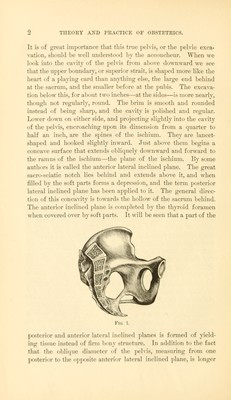
![than any of the others, it may be Bomewhat increased by the elas- ticity of some of the tissues. It will be Been that the Bpine of the ischium is the apex of the triangular Bpace lying below and between the two lateral inclined planes, the first point of resist- ance to the head in Binking down toward the bottom of the pelvis, and beyond which it cannot pass without change of position. It will be noticed that the anterior surface of the sacrum is concave from side to side, entirely straight from the promontory to the lower end of the third bone, and that the curvature commences at the fourth bone of the sacrum and continues almost in the segment of a circle to the coccyx, which is correspondingly bent forward, and thus extends the concavity. The anterior face of the sacrum and coccyx is smooth, with very Blightly elevated lines showing the former divisions between the pieces now joined together. The commencement of the h< >llow of the sacrum, as it is called, is therefore below the third bone, and that cavity is formed by the curve in the two last bones of the sacrum and the coccygeal extension. The upper end of the curvature is about on a level with the spine of the ischium. The direction of this straight surface of the sacrum is from the promontory downward, and very decidedly backward, forming an inverted inclined plane perpendicular to the axis of the plane of the superior >trait. The inner surface of the anterior or pubic wall of the pelvis is constituted almost entirely of the body of the pubic bone; it is smooth and concave from side to side, and forms a plane inclined in the same general direction of the upper anterior surface of the sacrum downward and backward. This correspondence in the direction of the opposing anterior and posterior walls of the pel- vis would unerringly conduct the head from the superior strait backward and downward to the hollow of the sacrum. The superior strait is formed by the projecting edge of the sacrum behind, the linea ilio-pectinea on the sides, and in front by the upper border of the symphysis. Authors usually measure the j-elvis in three different directions: at the superior >trait. from the promontory of the sacrum to the symphysis pubis is the antero- posterior diameter, and measures from 4j- to 4j inches; directlv across the centre is the bilateral, and is from .> to .') I mches long; the oblique diameter is a line drawn from the Bacro-iliac symphysis on one Bide to the ilio-pectinea] eminence of the oppo- site Bide; it> length is about 4[ inches. The diameters otf the](https://iiif.wellcomecollection.org/image/b21031368_0017.jp2/full/800%2C/0/default.jpg)