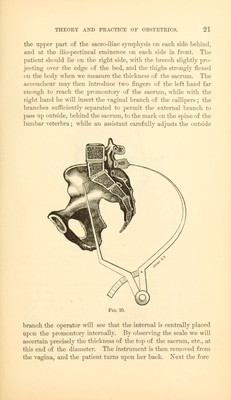
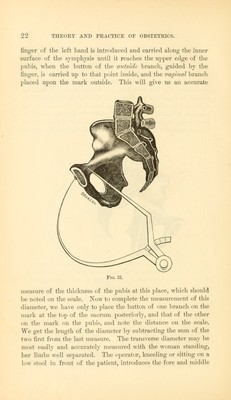
A treatise on the theory and practice of obstetrics / By Wm. H. Byford.
- William Heath Byford
- Date:
- 1870
Licence: Public Domain Mark
Credit: A treatise on the theory and practice of obstetrics / By Wm. H. Byford. Source: Wellcome Collection.
Provider: This material has been provided by the Harvey Cushing/John Hay Whitney Medical Library at Yale University, through the Medical Heritage Library. The original may be consulted at the Harvey Cushing/John Hay Whitney Medical Library at Yale University.
33/510 (page 19)
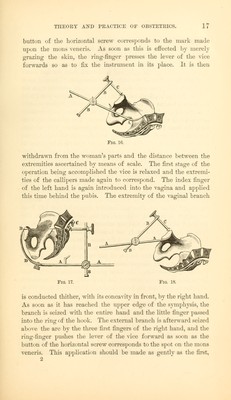
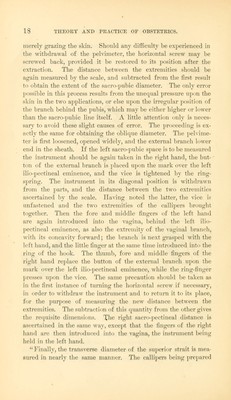
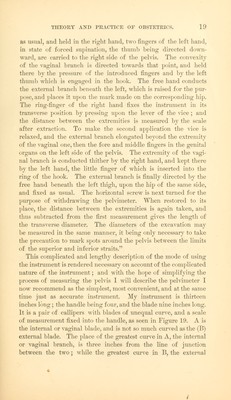
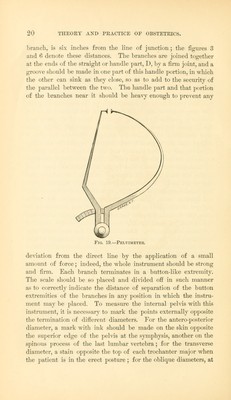
![as usual, and held in the right hand, two fingers of tin- lefi hand, in state of forced supination, the thumb being directed down- ward, are carried to the right side of the pelvis. The convexity of the vaginal branch is directed towards that point, and held there by the pressure of the introduced fingers and by the left tluinil) which is engaged in the hook. The free hand conducts the externa] branch beneath the left, which is raised for the pur- and places it upon the mark made on the corresponding hip. The ring-finger of the right hand fixes the instrument in its transverse position by pressing upon the lever of the vice ; and the distance between the extremities is measured by the scale after extraction. To make the second application the vice is relaxed, and the external branch elongated beyond the extremity of the vaginal one, then the fore and middle fingers in the genital organs on the left side of the pelvis. The extremity of the vagi- nal branch is conducted thither by the right hand, and kept there by the left hand, the little finger of which is inserted into the ring of the hook. The external branch is finally directed by the free hand beneath the left thigh, upon the hip of the same side, and fixed as usual. The horizontal screw is next turned for the purpose of withdrawing the pelvimeter. When restored to its place, the distance between the extremities is again taken, and thus subtracted from the first measurement gives the length of the transverse diameter. The diameters of the excavation may be measured in the same manner, it being only necessary to take the precaution to mark spots around the pelvis between the limits of the superior and inferior straits. This complicated and lengthy description of the mode of using the instrument is rendered necessary on account of the complicated nature of the instrument; and with the hope of simplifying the process of measuring the pelvis 1 will describe the pelvimeter I now recommend as the simplest, most convenient, and at the same time just as accurate instrument. My instrument is thirteen inches long ; the handle being four, and the blade nine inches long. It is a pair of callipers with blades of unequal curve, and a scale of measurement fixed into the handle, as seen in Figure 19. A is the internal or vaginal blade, and is not so much curved as the (B) external blade. The place of the greatest curve in A, the internal or vaginal branch, is three inches from the line of junction between the two; while the greatest curve in B, the external](https://iiif.wellcomecollection.org/image/b21031368_0033.jp2/full/800%2C/0/default.jpg)